
Stories
| Dachau | CMOH | Reunions | E-Mails | Memoirs |
THE INFANTRY RIFLEMEN The rifleman fights without promise of either
reward or relief.
Born 10/7/1902 Died 9/25/1985 Father Barry's obituary appeared in the Province Review November 1985. REV. JOSEPH C. BARRY, CSC, of Holy Cross House, Notre Dame, died unexpectedly there on Wednesday, Sept. 25. He had joined the community as usual for supper the evening before and was apparently well. Death came as he was preparing to go to the chapel for the 7:a.m. community Mass at which he was a regular concelebrant. Fr. Barry born Oct. 7, 1902, in Syracuse, New York, graduated from Holy Rosary High School (source of several other Holy Cross vocations: Frs. Michael Foran, Theodore Hesburgh, Charles Young (EP) and the late Regis Riter), and entered Holy Cross Seminary in 1923. He went to St. Joseph's Novitiate a year later and made his first vows on August 15, 1925. After graduation from Notre Dame in 1929,he studied theology at Holy Cross College, Washington, D.C., and was ordained in Sacred Heart Church, Notre Dame, on June 24, 1933. Fr. Barry was first pastor of the new Christ the King
parish, South Bend, for his first year after ordination, then assisted at St.
Joseph's parish, South Bend, until 1941, a period interrupted only by a stint as
teacher and prefect at Notre Dame in 1935. As army chaplain with the Thunderbird
infantry division 1941-46 he survived some of the fiercest fighting of the war: in
Africa, Sicily, Italy (Salerno and the Anzio Beachhead, the capture of Rome), and
finally the invasion of Southern France and Germany. After the war, he spent two
years as director of student affairs and prefect of discipline at Notre Dame, then
was associate vocation director during 1949-51. He returned to Notre Dame where he
was prefect of religion, pastor of Sacred Heart Church (1952-56) and assistant
prefect of religion (1956-61). After two years as chaplain at St. Joseph's Hospital,
South Bend, he was appointed chaplain at Archbishop Hoban High School, Akron, Ohio,
where he served for 19 years before ill health forced his retirement to Throughout his half century of priesthood, serving in a wide variety of apostolates, Fr. Barry was truly a sign of faith and hope and Christian joy for all those to whom he ministered. His three happy years at Holy Cross House were clear witness to these lifelong gifts. In his eulogy at the wake service in the Moreau Seminary chapel, Fr. William Craddick, assistant administrator and assistant superior of Holy Cross House, said: "At Hoban High School in Akron, happened what happened everywhere Father Joe went: he captivated young and old by his friendliness, cheerfulness and understanding. Many, and I mean many, Akron followers of Notre Dame football who came to home games would visit Father Joe at Holy Cross House and laugh with him. The Hoban High School affection for Father Barry was of no small degree. So beloved was he that when it came time to name the new gymnasium at the school, it was named after Father Joseph Barry." In his homily at the funeral Mass, Fr. Christopher O'Toole (SP) former superior general said: "Two years ago in this church, at this same hour, we celebrated the golden jubilee of Father Joe's ordination. Today we celebrate a victory, the victory of one who has persevered in his commitment to the end. We are here not just to pray for Father Joe, but also to pray with him, for he is a member of the Mystical Body of the Lord Jesus. We are here not to emphasize his physical absence, but to emphasize his spiritual presence-his union with us. He has been listening (to the Word of God) from the time he entered the seminary at Notre Dame. From that day to this the Word of God has been sounding in the depths of his soul. The Word of God pointing Father Joe to the religious life; to the novitiate; to perpetual profession and ordination to the priesthood. That Word has shaped his entire life…."
This article was written by Robert E. Donohue, Company E, 157th Infantry Regiment, 45th Division This incident happened in the Vosges Mountains during December 1944 while serving with Company E, 157th Infantry Regiment. Our company had made an attack during a full blown rain and ice storm and we ran into some major difficulties. During the fire fight I and another squad member name Strong got separated from the rest of the company. We unfortunately caught the attention of a concealed German machine gunner who began to systematically pursue the both of us in circles from tree to tree with a fusillade of bullets. We spotted a cavelike outcropping of rock on the side of a hill and dove for our lives under that rock. The German gunner had spotted us and persisted in hammering the rock and kept us captive unable to move out into the open. Since it was late afternoon we waited for full darkness to make a run for it, and we did. The machine gunner apparently heard us moving out, as he proceeded to blindly rake the hillside in hopes of picking off a hapless pair. The gunner failed to hit either of us, but in our haste and due to the pitch of darkness, I got tangled up in a mass of brushy undergrowth which caused me to trip and fall, resulting in the loss of my helmet. Later that night we made it back to our lines. I had just
managed to crawl up an embankment onto a muddy road when a three-quarter ton command
car skidded to a halt next to me and voice from within shouted: "Soldier, where
is your helmet?" Without waiting for a reply, a hand thrust a helmet through the
canvas side flaps and a voice said, The next morning when the company assembled to move out, I became the center of everyone's curiosity. Unknown to me, my new helmet had a bright silver cross on center front for all to see and wonder about. I learned later that the helmet donor was Father Barry the Regimental Chaplain. I kept the helmet for a long time, but Father Barry's silver cross lies somewhere in the woods of the Vosges mountains. (Father Barry retired to Notre University and is now deceased).
MY MOST REWARDING AND HAPPIEST REUNION My website http://www.45thInfantryDivision.com has been responsible for reuniting many people. This story is about a once in a lifetime occurrence. Jessica Hickling from Longmeadow, Mass. and Kathleen Gordon Rowland from Darien, Conn. saw an announcement on the front page of my website that the 157th Infantry Regiment was holding its reunion at the Adams Mark Hotel in Philadelphia, 6 to 9 September, 2000. Jessica and Kathleen did not know each other but decided to attend the reunion. Each was seeking information about their Dad, Robert A. Gordon, who served with Company "D", 157th Regiment, 45th Infantry Division and was killed 18 October 1944. Not only did they find information about their Dad but found each other. It was a very happy occasion and the climax of our reunion. I was exceptionally happy to have played a part in bringing Jessica and Kathleen together. My sincere wishes for continued happiness and joy to Jessica and Kathleen. The following story appeared in the Philadelphia Sunday Inquirer, 10 September 2000 written by Leonard N. Fleming. Al Panebianco
A lifetime of wondering, waiting ends in tears of joy for sisters Chance - and the Internet - bring WWII orphans together in Philadelphia. By Leonard N. Fleming Half sisters Jessica Hickling and Kathleen
Gordon Rowland never knew their father. And they had never laid eyes on each other.
WORLD WAR II MEMORIES OF TOM RIORDAN Retired newspaperman Tom Riordan, a 60mm mortarman and communication sergeant for Company G, 157th Infantry 45th Division, tells us, “My wife Marilyn made me do it.” Riordan refers to a 72 page booklet about his World War II experiences, created as a Christmas gift for our six children and eleven grand kids. The project took three months. Actually I enjoyed the job. With a few tears here and there. Remembering Father Joseph Barry and buddies like Patty Williams, Orin Scott, Andy Korus, Wilmer Wood (who was killed at Bundenthal), George Courlas, Roland VanBuren, Bill Hundermark, Bill Lyford, plus other assorted characters. Riordan recounts his 35 month military career, from basic training at Fort McClellan, AL to Munich. Riordan told his offspring, “Please remember, Dad was not a war hero, just an ordinary soldier who always tried his best.” He dedicated the volume to seven of his 1940 classmates at Detroit Jesuit High School, all killed during WWII.
TOM
RIORDAN WORLD WAR II TIMELINE June 18, 1942: As a 21 year old sophomore at Michigan State
College, enlists in U.S. Army April 12, 1943: Basic training at Fort
McClellan, Alabama August 1943: Assigned to Camp Croft, South Carolina December l943: Joins 87th
Division in Camp McCain, Mississippi March 1944:
Transferred into European replacement pool April 1944:
Depart USA on troop ship with 4,000 replacements to fill ranks of Italian campaign
casualties. After speedy Atlantic crossing, arrive Oran, North Africa. May 1944:
With about 400 men taken by small British ship to Naples, Italy June l944:
In hills near Rome, assigned to Company G, 157th Infantry Regiment, 45th
Division as a 60mm mortarman. Given one-day pass to visit Rome. July 1944
In area near Naples, 45th rebuilt and trains for amphibious landing into Southern
France near St. Maxine. August 15, 1944: Invasion of southern France. Next four months: Combat with 45th battling through
Vosges Mountains along western edge of France into Alsace. December 17,1944: Bundenthal, Germany hospital and Midnight Mass
Christmas Eve. January 13, 1945: Reipertswiller, France, one of 13 survivors from
Company G. January 26, 1945: Hangwiller, Alsace to refit 157th,
promoted to company communications sergeant. March 14, 1945: Transferred to 45th public
relations to write releases for hometownpapers of men winning decorations. May 7, 1945: Germany
surrenders May 30, 1945: Transferred into
Army of Occupation, serving as sports editor of Ninth Division News. October 1945: Shipped to USA
on USS General Breckenridge. October 24, 1945: Discharge from Army at Camp McCoy, Wisconsin. January
1946: Return
to Michigan State to complete college. AUGUST 15, 1944 – THE REAL THING Men of the 45th Division
boarded giant LSTs – Landing Ships Tank – in early August at Naples harbor. Navy
ships of various sizes escorted us, their big guns ready to pummel German defense
emplacements. This was it. The amphibious invasion of southern France. On the morning of the 15th we
were aroused at 2 o’clock for breakfast. We ate quietly. “Hope this goes like
the Anzio landing,” an old timer said. “No Germans to meet us.” Another
replies, “Sure as hell not like Sicily. That was a real SNAFU.” Father Joe Barry, the 45th’s
Catholic Chaplin, who served as a dorm moderator at Notre Dame before joining the army,
reminded us there would be a Mass in the hold of the ship at 4:00AM. By 3:30 it was
packed, GIs sitting on tanks, jeeps, trucks, boxes of ammunition and rations. Just before starting Mass, Father Barry
asked if someone could serve. I looked around. No one had volunteered. So I raised my
hand. “Father I can serve, but I don’t know all the Latin responses.” “That’s
OK soldier, I’ll answer the ones you can’t.” There I was, kneeling on the wide, wooden
ribs of the LST hold. Father beginning, “In the nomie Patris, et Fili, et Spiritus
Scanti. Amen.” I wondered, will this be my last Mass? Praise God. It wasn’t. For Company G, the actual landing was a
breeze. In our sector heavy dawn bombardments by naval guns had silenced German pill
boxes. Not a shot was fired by the Germans or us. Slogging through heavy sand, we saw
French civilians watching at the edge of the beach. They were cheering. For me, there was
one surprise. A plump, middle-aged French woman rushed towards us. Without warning, she
planted a wet kiss on my cheek. Our orders were to keep moving until we
ran into resistance. We force marched for two days, mainly through rain, until reaching a
little town called LeLuc – my baptism under fire. It lasted about 20 minutes. We set
up our mortars, but they weren’t needed. The Germans has quickly pulled back off. Our company commander was about to signal
us to move out when four French civilians joined him. They wore armbands with the letters
FFI. We were seeing our first Free French resistance fighters. “Anyone in the outfit
speak French?” the CO asked. George Courlas stepped forward. The Frenchmen excitedly
began to chatter and wave their arms. George listened carefully. “They say
there’s a German Mark IV tank hidden in the next village, sir. They want to knock it
out.” “OK,
tell ‘em to go ahead and do it.” And they did. As the weeks wore on we were in a variety
of battles. For some, our mortars played solid support roles. In others we dug into
defensive positions and waited. There were respites, even rest camp respites, hot showers
and fresh uniforms. But mostly we continued to move along the northeast border of France. My intention here is not to go into great
details about these actions, settling on two in Germany, which I remember best. The official history of the 157th
Infantry states: “The mission of the 45th was to break through the back
door into Germany by way of the Vosges Mountains.” That mission was accomplished. Company G contributed its share. NORTHWEST RECORD PEASANT GIVES FRESH MILK TO
DOUGHBOYS IN FRANCE
By PFC Tom Riordan November 3, 1944 (France, Oct 6) – The French people
are a sight to behold; their bright smiles and cheery greetings make a real hit with the
American soldiers. Bedecked in wooden shoes, the men in baggy pants and the women in long
plain dresses, the townsfolk are in front of their homes at all hours of the day and night
to greet the doughboys as they tramp through in pursuit of the Germans. Ever so often the
GIs would find a bottle of wine or basket of fruit offered to them. One of the nicest gifts I received while
our outfit was hoofing along on a very cool, rainy day was a bowl of rich warm milk just
taken from the cow. When the company halted for a break, our platoon stopped opposite a
tiny farmhouse. We had hardly sat down and loosened our equipment for the ten minute rest period, when the farm owner came
hustling out of his home with a big pail of milk. Following close at his heels were his wife and two children all clutching
little china bowls. They immediately began serving the
soldiers and everybody was smiling. As I sipped from the bowl offered me the chilly
feeling left my body and I felt good all over. “Merci, monsieur,” we told the
friendly peasant man of the soil, and proceeded to load him down with all our extra
cigarettes. American tobacco hasn’t been seen in France since the Nazi domination
four years ago, and the French smoker has had to puff on rationed German,
“tabac,” which has a large content of wood shavings in it. The smell of it burning is enough to make
even the veteran G.I. smoker take off for the nearest exit. It’s horrible, but taking a whiff of it helps you realize how much the
Frenchmen must appreciate our little gifts. This
unexpected act of love by a French farm family ranks as one of the sweetest events of my
nearly 18 months in Europe during WWII. Imagine a blustery and rain November day, a forced
march which seems to have no ending. That’s what the guys of Company G had going for
ourselves. Presto, warm milk to sip from bowls. Fresh from the cows. That was a treat. TWO TINY GERMAN TOWNS WITH
JAWBREAKER NAMES Let’s
start with Bundenthal during mid-December 1944. We’d been slogging through a deep
snowfall in a forest of giant trees. As guys in the ranks, we had no idea we were entering
a tiny corner of Germany. Or that the Siegfried Line was not many miles away. It was
late afternoon when we stopped. An officer huddled with the mortar squads. He said he had
a small force of GIs had been trapped in Bundenthal. Along with about 25 riflemen
we’d be strolling down the hillside and quietly rescue these GIs. Our
mission would start in about 45 minutes when it got dark. That left time for us to relax
from the day’s hike and enjoy a K-ration dinner. When
word to move came, we gathered our mortars, wondering what role they might play in the
rescue. As it turned out none. Moving out single file, we slipped and slid down an icy
path, which ran next to a large ditch . At the bottom of the hill the line of riflemen
turned left at a road and we followed. I
noticed a wrought iron fence running along next to us. Suddenly there was a burst of
German machine gun fire. We dove into a shallow ditch near the fence. Rifles began to pop.
Our guys were in a fire fight. The Germans had apparently waited until most of the column
had entered the town, then opened up. Now the rescue mission was itself part of the
beleaguered. We
crawled back along the fence and discovered an entrance into a cemetery. The lieutenant
decided we should hide among the tombstones. He said we’d head back up the hill at
dawn. That’s when we learned the ditch we’d seen in near darkness turned out to
be a giant tank trap. It was cut in a series of ledges to the top of the hill. He told us
to climb it, hopping up one ledge at a time. That worked fine until a German machine
gunner spotted our exit and began firing at us. Just
ahead of me Andy Korus of Texas yelled, “I’m hit in the leg.” I jumped to
his ledge. Both of us hugged the ground while
I tended his wound. There was another burst of fire, which just missed us. But tragically
Corporal Wilmer Wood of New Jersey. Bounding up to our ledge, was hit in the throat and
killed instantly. From that point there was nothing Andy and I could do but lay perfectly
still, pretending to be dead. At
dusk, stretcher bearers slid down the hill to remove Wilmer’s body. Another twosome
evacuated Korus. One of them told me, “The doctor says for you to come back with
us.” At the
aid station Andy was loaded into an ambulance. His war was over. (Fifty-five years later I
learned Korus was alive, albeit with a balky left knee. We exchanged letters. Andy said he
never knew the circumstances of being hit. So I filled him in.) The
field doctor pinned a “combat fatigue” tag on my jacket and said to join a group
of walking wounded. We soon were in an ambulance, bumping over rough roads, headed for a
small German hospital, taken over by U.S. Medical personnel. It was probably a dozen or so
miles from Bundenthal. You
may remember my Christmas 1944 story which ran in the Ocala Star-Banner. It recounted this
experience. Midnight Mass in the hospital chapel with about 75 GIs attending. The magic
moment when from the choir loft there was a burst of feminine voices, singing “Silent
Night” – in German. It turned out they were nuns who made up the hospital’s
regular nursing staff. My
story ended Christmas morning when Red Cross ladies passed out tiny gifts to patients. A
cake of soap, a razor, some shaving cream. Each was gaily wrapped in Yule paper. When a
gift-giver arrived at my bed she said softly, “I’m sorry, soldier, you arrived
after we made our head count. So there isn’t a present for you.” “That’s OK,” I smiled broadly, “I’ve already received the best gift of all – my life.” THREE BITTER DAYS AT REIPERTSWILLER About 50 years after the war ended I learned details of our battle near this town in France. It took place in late January, 1945. And I was there. What we didn’t know then, a rested,
well-supplied German SS mountain division, had swung down from Norway to the quiet
southern front, for one final all-out German assault. The combat-weary, undermanned 157th
Infantry was in the midst of being relieved by green troops. That spelled disaster. German 88 guns pounded American positions for three days. When the artillery lifted, Germans effectively infiltrated our strung-out forward positions, killing and capturing dozens of our men. The third day proved the most intense for
Company G mortar guys. Firing our guns almost continuously, we seemed to play tit for tat
with German mortarmen on the other side of the hill. “We’d let go a dozen
rounds. Before the third or fourth hit their lines, German incoming had us diving into
bunkers. First Sergeant Lou Wims led Company
G’s battered defensive force of maybe 40 riflemen atop the hill. He told us over our
direct-wire telephone hookup to pour out everything we had onto the attacking Germans. That led us to break the first commandment of firing a mortar: Only the gunner shall drop a round down the tube. But the hellish German counter battery that third day at Reipertswiller forced us into a forbidden technique. We would spread a GI blanket next to our bunker. Onto to it we placed about a dozen 60mm rounds.We tore off three of the four power bags (since our range was about 300 yards) and pulled each firing pin. Two guys would drag the blanket over the frozen ground to a mortar. Laying flat on each side of the gun, the pair took turns dropping rounds down the tube. When the blanket was empty, the pair scrambled for cover. On one such turn, a tail fin from my
buddy’s round, then exiting the tube, lightly sliced across a fingernail on the hand
I held a shell about to be dropped in. Yes, that scared the hell out of me. If my hand had
been a millimeter closer we could have been the only crew in the ETO (European Theater of
Operations) to self destruct firing our guns. Four years ago, Chan Rogers who later joined G Company called me about a reunion of the 157th in Myrtle Beach, SC. In the conversation Chan told me about a military historian was writing a book about the infamy of Reipertswiller. I contacted author Hugh Foster, a retired lieutenant colonel of the Vietnam era, to ask for data on those devastating days. Hugh sent me copies of his detailed research on the entire operation. From this I learned the gruesome facts. Most depressive were the statistics: the 157th Infantry suffered 158 killed, 426 captured and 600 wounded. Five companies, including G were completely gutted. Another author, Flint Whitlock, who wrote
a history of the 45th Division, entitled Rock of Anzio, reported, “The
battle of Reipertswiller was the most devastating single loss in the history of the 157th
Regiment.” When we remnants of Company G were pulled back, I counted 13 men.
WWII EXPERIENCES OF TECHNICAL SERGEANT RALPH W. FINK
Ralph Fink was sworn into military service at Allentown, PA on 3 March 1943. Left home on 10 March 1943 by train for New Cumberland, PA Induction Center. After several days there, entrained for Camp Wolters, TX for thirteen weeks of basic training. He then took a troop train to Camp Shenango, PA. This was a stop-over, waiting for overseas shipment. After about two weeks, shipped to Camp Shanks, NY and then boarded USS Alexander for shipment to Oran, Africa. After two weeks on the high seas and several replacement camps, he was assigned to Company “D”, 157th Regiment, 45th Infantry Division at Benevento, Italy, approximately 10 October 1943. Remained with Company “D” for the remainder of the war.
SANFORD KEITH BOWEN
Born 8/13/1918 - West Salem, OH. KIA 1/20/1945 - Reipertswiller, France Above is a picture of Sanford Keith Bowen with some of his buddies of the 1st Platoon, Company "I", 157th Regiment, 45th Infantry Division. This picture was taken December 16, 1944. He is in the front row, wearing glasses. Even at this late date, we are hoping that someone will recognize Keith and contact us. In the June 15, 1989 157th Infantry Association Newsletter, General Sparks related the following: "In early January of 1945, the German Army launched an attack towards the Alsatian Plains with the objective of breaking through to disrupt the Allied attack. This left the 45th Division, then already in Germany, in an exposed position, and the division was ordered to withdraw. The regiment withdrew to positions around Reipertswiller to counter the German penetration, known as the Bitche salient. Compounding the situation at the time, was the fact that the 45th Division had been in almost continuous combat for the preceeding 5 months. The fighting in the heavily forested Vosges Mountains and the subsequent penetration across the German border had been bitter and costly. Rain, snow, and mud made life miserable and supply difficult. Along with heavy battle casualties, sickness, and frozen feet resulted in severely depleted company strengths. There was probably not a rifle company in the division which could muster more than two-thirds of its full compliment of the men. Because of the Battle of the Bulge then nearing its conclusion, the Seventh United States Army, of which the 45th Division was a part, had been stripped of both replacements and units. The failure of their Ardennes offensive, known as the Battle of the Bulge, left the Germans desperate for a victory. In such desperation, a plan was conceived to drive Allied forces fromt he Vosges Mountains of Northern France. Fresh German troops were brought in, and the offensive against the thinly held Allied lines began. Standing squarely in the path of the German drive was the 45th Infantry Division and the 70th Infantry Division, newly arrived from the States, along with supporting troops. And such was the situation in which the exhausted troops of the 45th Division found themselves in early January of 1945, along with bone-chilling snowstorms. On the morning of January 14, 1945, the regiment, along with other elements of the division, launched a counterattack against the penetrating German forces. The ensuing battle lasted until the evening of January 20. While the German penetration was stopped, the regimental casualties were the heaviest of any single battle of the war. Companies C, G, I, K, L, and M were almost completely wiped out. Other units of the regiment also incurred heavy losses." Sanford (Sandy) Reed Bowen, son of Keith is currently writing, "The Biography of my father, Sanford Keith Bowen, a citizen soldier of WWII." Sandy and I have emailed each other for nearly two years and have met personally at our last two reunions. I am certain Keith would be very proud of his son. A great guy and a true gentleman.
DONUT DOLLIES CAPTURE A
"JERRY"
One morning Donut Dollies Monica (Woods) and Jo
(Betty Jones) took a jeep loaded with doughnuts for a run to a company just pulled
back into a 2nd position. Near to the company, the girls rode into a forest and
suddenly a "German Soldier" jumped out holding his hands up. Fortunately
they put the "Jerry" on the radiator and drove into the company area with
their capture. You can imagine what happened—that two Donut Dollies could capture a
"POW."
Before her demise, 1/20/96, Sally Stauffer donated all her Red Cross WWII memorabilia to the 45th Infantry Division Museum located in Oklahoma City, Oklahoma. While visiting the museum, I was able snap a picture of Sally’s Red Cross uniform being displayed on a mannequin. In a frame standing beside the mannequin is this description: "This Red Cross uniform was worn by Ms. Sally Stauffer who as a "Donut Dolly" served the 45th Infantry Division during most of its 511 days of combat during WWII". Sally was part of our group when we visited Europe in 1989.
On part of the trip she wore her Red Cross uniform and like a true "Donut
Dolly" she distributed literature and other goodies in towns where our bus
stopped. A dedicated "Donut Dolly" to the very end. Sally was a
very charitable person and a gal I will never forget. By Al Panebianco
LTC Hugh F. Foster III (Ret.) taken 9/88 at
the The following articles were written by LTC Hugh F. Foster III (Ret.). Hugh is writing a book on the Reipertswiller encounter. FORWARD (Outline) There is a hierarchy in an army in peace and in war, and each layer has its special function. For some, the conditions don't change whether it be peace or war. Others live a more spartan existence by moving into tents. At the lower end of the hierarchy however, there is a most fundamental change in wartime: people are physically and psychologically maimed, and many die. Most soldiers in a wartime army will never hear a shot fired in anger. However, is a time-honored, and much used army expression as true today as it was when coined. Shit flows down hill. In war, nowhere is the expression more apt than in describing the infantry, for the greatest burden of the killing and the dying rests with those soldiers. At this level, shots in anger are heard -- and felt. Fear, love, grief, and sacrifice defy adequate definition. Yet, these are the adjectives that best describe an infantryman's life in combat. Fear is the common thread; it binds all infantrymen together. It is a constant companion, sometimes close and clawing, sometimes lurking just below the surface of consciousness. It is usually controlled by force of will but it possesses every infantry soldier at one time or another. For an infantryman every step, every movement, each bend in the road, each house could be his last. The infantryman of WWII worked day and night. For those who lived there were infrequent and very brief respites that came without notice -- a brief spell in "reserve", a slight wound. The nights passed with four one-hour spells of restless sleep at best, many times with no sleep at all. Every day someone around him, someone looked upon as a family member, was killed, wounded or just disappeared. He performed his duty outdoors, among the elements, in the rain and in the snow regardless of the heat or cold. He rarely tasted hot food; for days or weeks he ate only cold food from cans. A change of clothes, an opportunity to wash his body were even more rare than hot food. Maybe, every month or so he got clean clothes and a shower. He lived like this, suffered this misery until he was killed, badly wounded, captured, or the war ended; for most infantrymen, these were the only ways out of the line. It was an utterly miserable experience, seemingly without end. As bleak as this sounds, the description is not adequate. The reality is that an infantryman's life in combat is much more terrible than words can convey. Just as the experience of childbirth cannot be adequately explained to one who has not been through it; the reality of infantry combat defies adequate description. Most battles, including the fight north of Reipertswiller, are strategically not decisive, and are ignored by historians, who concentrate on the big picture. This approach is a grave injustice to the vast majority of infantry soldiers, those who suffer, serve, and die for obscure objectives, for a nameless hill or a patch of trees. What follows is more than the story of the 157th Infantry at Reipertswiller; it is a story of ordinary riflemen in WWII, for there are many thousands who shared similar experiences and who have not been recognized by history -- or by their families or neighbors. What follows is not a story of a critical battle; the fate of a campaign did not hinge on a couple of hilltops north of Reipertswiller. Strategic eyes had never seen the name. But men suffered and men died there, for a piece of ground that meant nothing in the big picture. Few operations are strategically important; it is the whole that matters in war, the sum of thousands of small battles. It is the infantryman's lot to suffer and to die so that cumulative efforts, never perceived at his level, succeed. This is a story of infantry men, ordinary men who served their country in extraordinary ways. This is a story of heroes.
By the end of December, 1944, the 157th Infantry Regiment had seen more than 365 days of combat. The Regiment had deployed to North Africa with its parent division, the 45th Infantry Division, where it trained for and then conducted the assault on Sicily. After Sicily, the regiment participated in the Italian Campaign, including the landings at Salerno and Anzio, and the brutal mountain fighting on the way to Rome. Next, the Regiment landed in Southern France with the VII Army invasion forces. Late in December, 1944, the Regiment crossed the German border, but was ordered to hold up, and then to withdraw as VII Army spread out and shifted forces north in reaction to the German Ardennes Offensive, better known as the Battle of the Bulge. As the American units withdrew from exposed positions in Germany to a shorter, more defensible line along the border, the 157th Infantry Regiment found itself falling back to occupy fortifications in the French Maginot Line, vicinity Niederbronn. A German offensive against VII Army, intended to relieve the
American pressure on the Bulge, was launched on 1 January, 1945. This offensive,
known as Operation Northwind, drove deeply into the Lower Vosges Mountains, at the
juncture of the American XV and VI Corps. However, the weak American forces fought
stubbornly and after a few days the German salient was definitely contained. The
point of the German salient rested just north of the Once the German attack was halted American efforts were directed to reducing the salient north of Reipertswiller. The 157th Infantry Regiment, viewed as a relatively rested unit since the majority of the fighting had focused to the west of Niederbronn, was selected to push back the nose of the salient. 10 January: The regiment occupied its defensive sector with 1st and 3rd Battalions and 1st Battalion, 315th Infantry Regiment (attached) on line. Second Battalion was in reserve. Active patrolling and sporatic firefights characterized regimental operations. While the German attack had been stopped, bitter fighting still ensued along the whole periphery of the salient as the enemy vainly attempted to regain the initiative. Late in the afternoon 1st Battalion, 314th Infantry (attached to 45th Division) was thrown back from positions on Hill 388, just north of Reipertswiller. In response, 2nd Battalion, 157th Infantry (Companies E, F, G, H) was ordered after dark to move by truck to Reipertswiller, and attack immediately to retake Hill 388. Movement began after dark, and the battalion was not assembled in Reipertswiller for several hours. The night attack was launched just before midnight, and the men moved up the slippery, forested slopes of a hill they had never seen in daylight. 11 January: Second Battalion occupied the hilltop positions early in the morning without meeting any resistance. This situation changed dramatically with first light. For the rest of the day the Germans attacked the battalion, infiltrated the lines, and engaged the American troops with deadly accurate sniper fire. The fighting was close, bitter, and continuous, but the battalion managed to hang onto the objective. 12 January: Second Battalion continued defensive fighting near Hill 388 throughout the day. Late in the night the battalion was alerted to prepare to turn over positions to the 314th Infantry, which had reorganized, and then to assemble in Reipertswiller. 13 January: Relief of 2nd Battalion began just after midnight and the companies were assembled in Reipertswiller at dawn. The battalion was ordered to move immediately to occupy defensive positions vicinity Hill 415, northeast of Reipertswiller. Lieutenant Colonel Brown, the Battalion Commander, was told the rest of the Regiment would arrive later in the day and would attack the next morning -- 2nd Battalion would be in reserve during the attack. G Company moved to the top of Hill 415, proper; F Company took positions to the left (west) of G Company; and E Company occupied a reserve position generally behind F Company. There was heavy shelling all day as the battalion relieved elements of the 276th Infantry (attached to 45th Division). First Battalion, 157th Infantry, moved late in the afternoon to occupy positions to the right (east) of 2nd Battalion. A Company moved to a position to the right front of G Company, on the forward slope of Hill 415. B Company went into position to the right rear of A Company, on the edge of a draw -- no American unit could be found to the right of B Company; the area was open all the way to Rehbach. C Company occupied a reserve position to the rear of Hill 403. Third Battalion moved into an assembly area about 3 kilometers behind the line. During the night, small groups of the 276th Infantry were located in the woods, where they had been abandoned during the frenetic withdrawal of their unit. 14 January: Just after sun-up ist and 3rd Battalions kicked off the attack. C Company leading the 1st Battalion attack, intended to attack from the east side of Hill 415 and follow across the east side of Hill 363 to its objective, the Hill 390 ridge. However, navigation in the snowy forest was very difficult; the company missed a trail fork, moved behind Hill 415, and passed through F Company, on the west side of Hill 415. The company commander realized his error, but there was nothing to do except notify battalion and keep going. Just past the front line, C Company hit stiff resistance and was driven to ground just short of RJ 328. The whole column was halted and subjected to heavy artillery fire. Third Battalion, moving in column, passed through F Company and ran into the rear of C Company. C, I, K, L, and F Companies, clustered together in a small area, were subjected to heavy shelling. After awhile, 3rd Battalion moved off to the left (west) and as they got out of the shelling, the companies peeled off the march column to resume a northerly route toward Hills 400 and 420. The battalion halted for the night about halfway to those hills: I Company halted for the night in the Fliess Draw, just to the west of Hill 363; L Company halted on the forward slope of Hill 341; and K Company halted in the Spielbuchel Draw along the trail between Hills 341 and 401. Unbeknownst to Lieutenant Colonel Sparks, 3rd Battalion Commander, the 1st Battalion, 315th Infantry, had moved into the area immediately north of Reipertswiller early that morning and had also attacked to the north. C Company/315th took Hill 401 by the end of the day. B Company/3l5th and K and L Companies/l57th had cris-crossed each other's trails during the day; at dark, B/315th had established itself between K and L Companies. Second Battalion remained in place during the day, under heavy shelling. 15 January: First Battalion/3l5th remained in place during the day, and was alerted to withdraw the next morning. Third Battalion moved out again at daylight and brushed through relatively light resistance from remnants of the 476 Grenadier Regiment, 256 Volksgrenadier Division. L Company was the first of the 3rd Battalion units to move onto the hill mass. Just before noon the company came through the saddle between Hills 420 and 400 and moved east onto Hill 400, taking several prisoners and establishing a line running along the northern slope of the crest and hooking back to the south at the right flank. There was no contact with anyone to the right or to the rear, or with I Company which occupied the saddle later in the afternoon. Just after L Company got onto Hill 400, K Company climbed onto Hill 420, having come through the saddle between Hills 400 and 420, and occupied the hill with the main line of the company facing generally to the west . However, 1st Battalion, attacking on the right, was held up by determined resistance centering around RJ 328 and was unable to progress beyond this point. C Company could make no headway against Hill 363. B Company conducted an attack across the Brambach Valley to seize the ridge extending northeast from Hill 415, but was repulsed after gaining the ridge. At about 1600 hours, I Company also moved through the saddle. Two platoons occupied positions on the northern side and the remaining platoon defended the south side of the saddle. I and K Companies were physically tied together, but neither had contact with L Company. Occupation of the hills by 3d Battalion constituted a penetration of the German Main Defense Line, and in response, the German Corps Commander ordered the uncommitted 1lth Regiment (Reinhard Heydrich), 6th SS Mountain Division (Nord) to retake the critical terrain. Almost as soon as I Company arrived on the saddle, the hills were subjected to two or three violent German counterattacks -- some Germans managed to get behind the battalion. SS troops participated in some, if not all, of these attacks. By the end of the day, I Company -- which had arrived on the hill with 100 men -- was down to 91 GIs. L Company was down to 95 of the 106 men who had gained the hill, and K Company had 79 men left out of the 99 who had moved onto the hill. In response to the attacks against 3rd Battalion, E Company was ordered to move from its reserve position to Hill 341 to block against any German breakthrough of 3rd Battalion's positions. This move was accomplished without problem and E Company dug in on the northern nose of the hill, where L Company had spent the night of 14-15 January. 16 January: C Company was ordered to bypass the German resistance on Hill 363, and to join 3rd Battalion; this the company managed to do and by about noon it had moved to Hill 420 and occupied positions to the rear of L Company. The company was to have continued the attack by moving down the ridge line to the east, but this attack never materialized. German infiltrators were slipping around the flanks of the hills, and when the C Company supply sergeant attempted to bring three jeeps of supplies to the company later that afternoon the convoy was ambushed and all but two of the men were killed or captured, and the jeeps and their supplies were lost to the Germans. After C Company linked with L Company on Hill 420, B Company was ordered to move along the same route, again bypassing the German defenses on Hill 363. As B Company moved down the slope of Hill 415, mortar fire wounded several men, including Captain Stough, the Commander. The only other officer in the company, Lieutenant Castro, assumed command and continued the movement. However, the company was stopped at the base of Hill 341 by intense German fire from new positions behind L and C Companies, and was driven to ground. Since B Company's effort to link with 3rd Battalion on the
right flank had been stymied, Regiment decided to try to link with the forward troops
by attacking toward the left rear of K Company. G and E Companies were ordered to
move to Hill 401, relieve elements of the 315th Infantry (attached to 45th Division)
and to attack down the ridgeline to link with K Company on Hill 400. Both companies
conducted the move to Hill 401, and late in the afternoon began to move down the
ridgeline in column, with G Company in the lead. Germans cut the column after dark,
separating G Company, one platoon (2nd) of E Company and some H Company machine gunners
from the rest of the column. Efforts were made to fight through this German
resistance, but to no avail. Those elements north of the break in the column
joined with K Company well after dark and occupied positions facing the ridgeline
along which they During the day Regiment created a Composite Company from members of the Regimental Headquarters Company and the Regimental Antitank Company. This company was ordered to block the Spielbuchel Draw between Hills 335 and 350; it moved into position late in the afternoon. Resupply efforts through the valley were successful during the day and night, and these operations funnelled through a trail leading up the rear of the saddle. Two light tanks and two M-8 Scout Cars managed to reach the forward area, although they did not have sufficient traction on the steep, slippery trail to get over the saddle. The Tanks were ordered to remain to bolster the rear defenses of I Company, but the Scout Cars were to return. The two light tanks took positions in the I Company line, facing to the rear in the saddle between Hills 400 and 420. Although some of the wounded were evacuated, there were 16 litter cases who could not be carried on the scout cars. By midnight, 16 January, the Germans had succeeded in surrounding the hills, which were well forward of the general US line. From this point on, there would be no reinforcement or withdrawal of the surrounded 3d Battalion and the other men who had managed to break through to the hills. Although the two other battalions of the 157th Regiment, two additional battalions attached to the regiment in the next few days, a regimental composite company, and a platoon of medium tanks continually attacked to break in to the surrounded troops, no future efforts would succeed in breaking the German ring. When the Germans closed the ring around the men on these hills during the night of 16-17 January 465 American soldiers found themselves surrounded. 17 January: Third Battalion and attached units defending Hills 400, 420, and the saddle between them continued to fight off German attacks and to suffer heavy shelling. That portion of E Company not cut off on the hills tried to attack down the ridgeline, but was not successful. During the night the Composite Company was ordered to link up with B Company on Hill 341. The company set out in two groups: one group, accompanied by two tanks moved up the Spielbuchel Draw; the other group, with the company commander, headed cross-country. Both groups encountered heavy resistance and were driven back. The company commander was killed. Late at night, Lieutenant Talkington, 3rd Battalion Ammunition & Pioneer Platoon Leader, guided a light tank with a trailer of supplies to the forward area. These were the last supplies received by the surrounded men. 18 January: Shortly after midnight, LT Talkington tried to return to the rear with the light tank and trailer. Not far from the hills, the tank was ambushed at close range. Talkington, lightly wounded, escaped in the forest and regained the lines. The three tank crewmen were all wounded and captured. German infiltrators, in strength, had finally closed all supply avenues through the valley -- the hills were well and truly cut off. Just at dawn the Germans launched a violent counterattack against the G and E Company positions. The attack was so sudden and was initiated at such close range that there was hardly time to react. Some survivors reported that the Germans used flame throwers in this attack. The E and G Company men were thrown from their positions. Many men were killed or captured and all machine guns (possibly as many as four) were lost as the survivors dashed back into the K Company line. Only 18 men from G Company made it to the K Company line, and it is possible that all the E Company men were lost, for there is no further mention of this platoon in the journals and reports. Desperate to break in to the surrounded troops, Regiment
ordered all battalions to renew their attacks with all available men. None of these
attacks succeeded. Third Battalion's Antitank Platoon attacked across Hill 350, but
almost immediately ran into Germans, were driven to ground and pinned down. A squad
leader escaped at great risk, made his way to the battalion forward command post, and
informed Lt. Col. Sparks of the platoon's plight. G Company, 179th Infantry, was attached to the Regiment and went into position in the Fliess Draw, facing Hill 363. The remainder of the battalion was alerted for attachment to the 157th the following day. Upon moving into the area in the morning G Company, 179th Infantry, and a section of medium tanks moved up the trail and attacked Hill 363 from starting positions just to the east of Hill 341. The tanks remained on the road and fired over the heads of the attacking troops. The attack failed. G Company, 179th Infantry, assumed defensive positions and fought off German patrols attempting to infiltrate into the draw around both its flanks. In the evening the tanks withdrew. In the evening the remainder of the Composite Company was once again ordered to link up with B Company on Hill 341. This mission was accomplished, and the 20 or so remaining Composite Company men joined the equal number of B Company men who remained on the hill. 19 January: While the soldiers trapped on the hills continued to resist German attacks and heavy shelling, Companies E, and F, 179th Infantry, arrived during the day and were ordered to attack up the Spielbuchel Draw to break in to the surrounded companies. The two companies were able to progress to a position on line with B Company/Composite Company on Hill 341 before they were stopped by German fire. Subsequent attacks, even with direct tank support, were repulsed by the Germans. A and F Companies and G/179th renewed attacks against Hill 363, again without success. G Company, 179th Infantry, and a section of medium tanks attempted to reach C Company and Hill 400 by attacking directly up the trail from a starting point near Hill 341. The attack failed, and the troops and tanks withdrew. The remnants of E Company, bolstered by cooks and headquarters personnel, renewed attacks down the ridge leading to Hill 400, also without success. Late in the day, 2nd Battalion, 411th Infantry, was attached to the 157th. The battalion established an assembly area and prepared to attack the next morning to take Hill 363. 20 January: Early in the morning 2/411th attacked over Hill 415, heading for Hill 363. It conducted three unsuccessful, costly attacks. In the afternoon an attempt was made at aerial resupply of the surrounded troops. No supplies got the the men due to weather. The men could hear the planes, but all supplies fell into German hands. Also in the afternoon the Germans sent a party under a white flag to give a message to the American commander of the surrounded troops: Further resistance is futile; surrender by five o'clock or suffer the consequences. When Regiment was notified of the ultimatum, the surrounded troops were ordered to break out by attacking down the ridge toward Hill 401. The leaders rushed to inform the men that at the precise
time the German ultimatum ran out, the men would try to attack to the rear. An
artillery preparation was laid on to blast clear a path along the ridge and then to
follow the men off the hill. Non-ambulatory wounded were told they would have to
remain in their holes and place their fate in the It took a long time to pass the word about the attack and there was a delay in assembling the men. it was snowing heavily, and just as most of the men were out of their holes and trying to get formed up, the American artillery barrage came in -- right on top of the GIs. Many were killed and wounded. There was much confusion and, although some groups tried to proceed with the attack, there was little cohesion and the German troops swarmed upon the shocked men. The last words Regiment heard from the group came over the K Company radio: "Stop the artillery. We're surrendering." Late that night the US corps withdrew, leaving the survivors to their fate. Only three soldiers (two from I Company and one from K Company) returned to the US lines. Four hundred and six American soldiers were captured -- according to German records, most of them were wounded, Fifty-six American soldiers lay dead or dying on the hills. In the fighting to gain the hills, and then to break in to the surrounded troops another 88 American soldiers were killed and more than 350 were wounded and evacuated, and another 300 were evacuated for illness or injury. In the five-day fight for these hills, losses to the US forces totalled over one thousand men. To this day twenty of the 144 soldiers killed in this fight remain listed MISSING IN ACTION.
This article written by Dan Dougherty who is publisher of the quarterly newsletter, Second Platoon, Co. "C", 157th Regiment, 45th Infantry Division. GETTING RELIGION When the Army Specialized Training Program (ASTP) folded in March of 1944, my unit at St. Louis University was sent (kicking and screaming all the way) to the 44th Division on maneuvers along the Sabine River that joins Louisiana and Texas. All of the ASTP guys were privates and had no infantry equipment and most had no infantry training but the maneuvers did not halt one second while hundreds of us were integrated into rifle and weapons companies. I’d had a seventeen week infantry basic training prior to ASTP but for the guys who had given up cushy jobs and rank so they could go to college in the Army, a really bad dream had come true. After a week or so of slogging around in the muck, the
maneuvers recessed on Thursday of Easter week for a two day break. The next day -
Good Friday - the division was marched to a large hillside where we sat on our
helmets. After the inevitable Army wait, a jeep drove up at the bottom of the hill
and an altar was set up complete with loud speakers. Then a Catholic mass was said
for the entire division. Some of us closed our eyes and plugged our ears in
silent protest. The next day the maneuvers resumed. The Army in its infinite wisdom
had decided that since no one would be able to celebrate Easter that year, the entire
division - Catholic, Protestant, Jew and agnostic alike - would observe Good Friday
together. I’m sure many families and Congressmen heard that week about the U.S.
Army’s version of the separation of Some months later, Leonard S. "Pinky" Popuch (ASTP at the University of Minnesota) and I were a rifleman and BAR gunner respectively in K Co of the 324th Infantry Regiment fighting in Alsace with the Seventh Army. The 44th had started fighting in October when it relieved the 79th Division and in the big push which began November 13 we helped take Strasbourg ten days later and our regiment was the first U.S. Army unit to reach the Rhine. Then one morning - now late January 1945 - Pinky and I were abruptly promoted from Pfc to S/Sgt and sent to the 45th Division. It was the only time in my military career that a jeep was waiting for me and we weren’t even given time to say goodbye to guys we’d been with for almost a year. That afternoon we found ourselves squad leaders in different platoons of C Co of the 157th and learned we were one of six companies being reformed after the wipeout at Reipertswiller (1). Hundreds of replacements arrived from the depots and non-coms came from all Seventh Army divisions including Ben Ewig from the 103rd. Officers were scrounged from everywhere including Ft. Benning. We trained for one week and went back to the line. Instant infantry. Now, there must be an Army manual somewhere that says that one week after joining a new unit, the G.I.’s are to have a mandatory session with the Chaplain because, sure enough, after supper on the final day before we were to leave for the front, we were herded into a French school house to have a session with Father Barry, the First Battalion Chaplain. I prepared once again to close my eyes and plug my ears but this time it was different. The room was dimly lit and I could hardly see but the voice was loud and clear. The Chaplain’s message was brief, fifteen minutes at most. There was no religious service and no prayer. Instead, in some very direct language Father Barry told us why we shouldn’t desert! The G.I’s of C Company had gotten religion - Thunderbird style! The following biography of Father Barry is from Dachau - The Hour of the Avenger (2) by Howard A. Buechner: Capt. Joseph D. Barry - Chaplain. Father Barry of Syracuse, New York was awarded the Silver and Bronze Star Medals for assisting in the evacuation and comfort of wounded and dying soldiers on Anzio, under extremely Hazardous conditions. He was born in 1903 and died in 1985. For many years he was associated with Notre Dame University and was Chaplain of the Notre Dame football team during the coaching era of Frank Leahy. Father Barry joined the 157th Infantry Regiment at Camp Barkeley, Texas, in 1943, and "went all the way" to war’s end in Munich, Germany. He was a man of unfailing good humor and outstanding courage and was one of the most beloved clergyman of the 45th Division. It is easy for me to picture Father Barry in the locker room at halftime with the Irish down by ten points. He’d be light on theology and heavy on "Don’t quit fighting!" (1) See Monograph #9 on Operations near Reipertswiller by Felix Sparks available from 45th Division Assn, 2145 N.E. 36th St. Oklahoma City OK 73111, $2 plus $3.25 S&H per order. (2) Available from Thunderbird Press, 300 Cuddihy Drive, Metairie, LA 70005. $14.95.
The following article appeared in the Second Platoon, which is a quarterly newsletter written and published by Dan P. Dougherty. Dan served as a Squad Leader and then Platoon Guide in the Second Platoon of "C" Company, 157th Regiment, 45th Infantry Division. SNEAKING INTO A PRISON CAMP by Daniel A. Ficco
Editor’s note: Dan Ficco went overseas with C Co and participated in amphibious landings at Sicily, Salerno, Anzio, and Southern France. He was subsequently captured in Reipertswiller in Alsace on January 17, 1945. Despite the fact he has a serious health problem, Dan has at my request made the time and effort to write up some of his experiences which I’m pleased to share with readers. You’ll see he too "served" in C Company in the post-Reipertswiller era! Dan is now eighty years of age and resides in Petaluma, California. I was Ed Speairs’ 1st Sergeant, Company Clerk, Supply Sergeant and anything else we needed. He was a very good company commander and he and Felix Sparks were two of the best officers I have known. I can tell you my experience of escaping the prison camp at Mooseberg, Germany near Nuremburg. It is about 30 kilometers north of Munich. In a POW camp there were always rumors about what was happening. They said 1st Battalion, 157 Infantry was in Munich. I crawled through a hole I made in a fence just before dark and got into Mooseberg. A friend of D Co came with me. We crossed a street and saw a box of cigars in a store window. There were many German soldiers in town and to cause a diversion I threw a rock through a window while my friend grabbed the cigars. The German soldiers came running to the store and we ran down a ditch. It took us a few days to get through the German lines and across the American lines. When I found C Company, I didn’t know many men - just the cooks and a few others who had been there before. All my personal belongings were gone - pictures, a camera and several pistols I had picked up. The first thing I wanted was food. I ate too much and was sick for a couple of days because my stomach couldn’t handle the solid food. My normal weight was 175 pounds and I now weighed on 90. I never thought I would sneak into a prison camp. Father Barry was our 1st Battalion chaplain and another of the best. We’d had a lot of experiences together. He came to C Company and told me to go back in the prison camp! It had been liberated and we would be flown to a RAMP Camp (Reclaimed American Military Personnel). Father Barry couldn’t take us back in the camp so he took us near there and we crawled back in through the same hole!
A TRIBUTE TO PFC FRANCIS HENRY (BUD) DOHERTY
Company L, 157th Infantry Regiment, 45th
Infantry Division, 7th Army FRANCIS HENRY DOHERTY was born on June 22,
1915, in Malone, Franklin County, New York. He was the eighth of nine children of John
Henry Doherty and Caroline McCaffrey Doherty, and the great grandson of early nineteenth
century northern New York settlers and Irish immigrants Hugh Doherty and Bridget Meighan
Doherty. -- Edward J. Doherty --
THE STORY OF ASCHAFFENBERG My good friend Bob LeMense was going through some of his World War II memorabilia and found a pamphlet entitled, "The Story of Aschaffenberg". This pamphlet is a condensation of the newspapers and radio coverage of the siege of Aschaffenberg. It was prepared by the Public Relations Office, 45th Division, for the troops of the 157th Infantry Regiment who reduced the city to rubble and forced its capitulation after six days of bitter assault. In it are copies of press releases that were filed with the major newspapers and syndicates of the United States. From the pamphlet, I selected the article that appears on the next few pages. I might add, that Bob LeMense was a platoon leader, 3rd platoon, in company L, 157th Regiment. It was Co. "L" that took the town of Dachau which adjoins Camp Dachau. Bob was one of the editors who helped to put the 157th Regimental Book together. Many thanks for your support and encouragement. Talk about history repeating itself. Aschaffenberg was taken by the 45th Division, April, 1945. Exactly 54 years later, even to the months, we have a similar situation in Kosovo. As I was reading and typing the Aschaffenberg story, I was amazed at their similarity. The following pictures show the barracks that housed Major Lambert’s future German officers and convalescents. It was on a grassy incline, as shown in a few pictures, that many of our bazooka men were picked off by snipers from behind. After the war, American troops occupied the barracks for a number of years.
The Story of Aschaffenberg WITH THE 45Th DIVISION IN ASCHAFFENBERG (April 4,1945)-- This is the story of the amazing climax of the siege of ASCHAFFENBERG. Here is what happened behind the shattered and scarred walls of the city, known to grim-humored infantrymen of the 45th Division as !Cassino-on-the-Main!. This is not the story of the endless bombing and shelling of a fortress town. It is the record of one man's fanaticism and of his ultimate capitulation. Used as a replacement and convalescent center by the Wehrmacht, ASCHAFFENBERG was a quiet town whose peaceful serenity was broken only occasionally by the screams of some poor tortured soul in the Gestapo headquarters. German troops, returned from hospitals awaiting shipment to their parent units, strolled through the town and admired the Bavarian countryside. At night, the steady drone of American planes reminded the townspeople that there was a war being fought somewhere far to the west on the other side of the glorious defenses of the Siegfried Line and the Rhine River. On March 15th, the 4th Division penetrated the Siegfried Line. Three days later veteran Thunderbird troops were through the line. March 26th the division crossed the Rhine River and sped across the fertile valley of the Rhine. The war came to ASCHAFFENBERG on the 27th of March. There were two men in the town who were responsible for the execution of der Fuehrer's orders to defend the Reich. One was a short, bespectacled HEIMUTH WOHLGEMUTH, Kreisleiter (Nazi Party Leader for the County); the other was close-cropped, Prussian- backed Major of the Wehrmacht, Lambert, military commander of the garrison. Rumors of the Americans' advance preceded the troops with alarming frequency. Major Lambert and the Kreisleiter conferred. When the 45th Division's tanks rolled across thirty miles of the Rhine valley and headed for ASCHAFFENBERG, the two leaders of the town knew that their hour had come. Here was the chance to show their love for the Fatherland. Here was the chance to place themselves at the right hand of the Fuehrer. There were more than three thousand troops and many officers with rank as high as colonel among the casual convalescents in the replacement battalions of ASCHAFEENBERG. Major Lambert ordered all troops to report immediately for active duty, all officers to assume active duty of the troops. !These orders will be carried out immediately,! He proclaimed. Then the Kreisleiter issued an order to the civilians. He designated Wednesday and Thursday (March 28, 29) as days on which the civilians who wished to evacuate the town could leave. All others he said, would be used in the armed defense of the town. The ASCHAFFENBERG training area was dotted with concrete and steel pillboxes that had been used for training purposes. These casements were linked by a trench system and the hills around the town made an excellent defense. Lambert manned the physical defenses and sat back to wait. But one officer had not reported for duty. Word came to the Castle which was being used as a joint Gestapo and military headquarters that LT. FRIEDL HEILMANN was still in town and had not assumed his new command. Lambert, fired by the frenzy of his fanaticism, ordered Heilmann broought before him. There was no trial, no court martial. Wednesday morning, Heilmann was hanged from a buttress of the castle. His body swung in full sight as a visible reminder of what would happen to deserters, until an American artillery shell cut it down. The siege had begun. All day long, planes swooped over the town as heavy demolition and fragmentation bombs mush-roomed below. Great artillery pieces pounded the town. Rubble and debris showered into the air. Houses crumbled and the factory’s steel beams were twisted with the concussion. For four days the town was contorted in a convulsion of explosions. Some of the troops, unable to take the continued pressure, attempted to slip through the lines of our forces. On command of Lambert, they were machine-gunned and killed. Civilians who had managed to save themselves by hiding in the cellars of the city tried to get out. Again, Major Lambert ordered his machine guns to fire on them. They were killed. In the garrison, officers who ranked the major attempted to persuade him to surrender the garrison. One colonel who later was captured by the Thunderbird troops, said that he had pleaded with the major to surrender the garrison, but the major had told him to go back to his post or be shot. Yesterday, fifth day of siege, prisoners reported that Lambert had brought in 50 SS troops. These troops were ordered to shoot and kill anyone who did not resist to the end. Again, Lambert issued an order. The garrison of ASCHAFFENBERG would fight to the last man. Still the bombing and shelling continued. One lieutenant,
taken prisoner, estimated that more than 1500 dead lay in the town. But the
resistance in the town, fired by the threat of death at the hands of the SS went on.
Thunderbird troops, forced a wedge into the southern tip of the town. From room to
room they fought into the town. It wasn’t a case of cleaning one room and having
the rest of the house surrender. Each room had to be cleared in a separate As the 45th Division troops inched ahead, German snipers infiltrated through the heaps of debris and harassed the doughboys from every possible vantage point. In some cases, civilians sniped at our troops. A Luftwaffe captain, almost isolated in a house, attempted to surrender his little group. SS men fought through to him, hauled him back to Lambert and again, without trial, on arbitrary order from the commandant, he was shot. Late yesterday morning, Lambert called in his senior officers. "I am going to see if we can reinforce the garrison," he said, "I will be gone tonight, but I will be back. I order you to remain here and fight to the last man. When I come back, you’d better be here. The garrison, under threat of ultimatum, continued its resistance. On the night of April 2nd, COL WALTER P.O’BRIEN, commander of the 157th Infantry that had besieged the town, reshuffled his battalions. He sent LT COL. RALPH M. KRIEGER (Craig , Colorado) to take his battalion, the First, into the northeast end of town. In the south and southwest, O’BRIEN sent the third battalion under LT. COL. FELIX L. SPARKS of Miami, Arizona. And the regimental commander completed his ring of steel around the fortress city with his second battalion, commanded by MAJ. GUS H. HEIIMAN (University of Virginia). The squeeze was on. Throughout the night of the 2nd and the morning of April 3rd, the squeeze tightened as the 45th Division troops converged on the town. All avenues of escape were cut. All hope of reinforcing or supplying the garrison were ended. By nine o’clock of the night of the second, eleven hundred prisoners had been taken out of the town. But those who remained fought bitterly or died in place. In the meantime, during the previous three days of the siege, Lambert ordered the execution of four more men who attempted to leave the city. On one grisly product of his fanaticism, Lambert hung a sign "I tried to run away." The ghastly warning swung from a telephone pole until after the surrender of the town.. Lambert never left the fortress. Hemmed in on all sides and with the iron jaw of the 157th’s vice closing in on him, he found it impossible to leave the city. As the total of dead mounted in the fortress and bombardment increased in its intensity throughout the night of the 2nd, Lambert began to think of capitulation. At 0700 this morning, he ordered an American soldier who had been captured last Sunday, to be brought before him. Then he designated a captain of his staff to go with the G.I. to negotiate for a surrender. He gave the captain a note to the American commander. At COL. O’BRIEN’S C.P.. the captain delivered his message. COL. O’BRIEN was in no mood for bargaining. "Tell Lambert, he said, "That he doesn’t wave white flags from the castle as a sign of unconditional surrender, I’ll level the place to the ground!" A few moments after the captain returned to the garrison the white flags from the castle fluttered out of the highest windows. The siege of ASCHAFFENBERG has ended. At 0900, Major Lambert, dressed in high polished boots and a long green overcoat with a peaked cap of the Officers Corps of the Wehrmacht, strode out of the besieged town accompanied by his staff. Formal surrender was made to COL. O’BRIEN, but the 45th Division commander was not content merely to accept the capitulation. He ordered Lambert to return to the garrison, with an escort of men from G Company. Riding in the first jeep of the convoy, Lambert called out to the remaining men of the garrison to lay down their arms and give up. The long procession that leads to the PW cage was on its way. Awaiting evacuation, Lambert looked once at the still-smoldering ruins of the town which his fanatic threats had brought to shambles. Then Major Lambert, former commandant of the garrison, turned his back on ASCHAFFENBERG. SECRETARY STIMSON SPEAKS WASHINGTON, April 7 (ans)—The German people were warned by Secretary of War Henry L. Simpson yesterday that they have only a choice between immediate unconditional surrender or the same form of capitulation "a little later after much more of the Reich has been destroyed city by city."
World War II Experiences of Clarence B. Schmitt This is a story told by Clarence B. Schmitt who was a member of Co. "M", 157th Regiment, 45th Infantry Division When the war started, there were five in my family drafted but the sixth brother John, they would not take as he was older and was involved in war work. When we wrote to our father, my brother John would save all the letters. I was drafted and sent to Camp Lee, Virginia. After a short stay at Camp Lee, I was transferred to Camp Wolters, Texas for basic training. Attached is a copy of the first letter I sent home dated 3/5/43. Also, a copy of the first letter from Camp Wolters dated 3/21/43. After thirteen weeks of basic training at Camp Wolters, we shipped out to the Port of Embarkation located in Shenango, PA. See letter dated 7/11/43. We were then sent to Camp Shanks, NY to board ships headed for Oran, North Africa. After a few in Oran, we were put on a train and went across North Africa to Bizerte. A couple of days later, we boarded an LCI and headed for the beaches of Salerno. I was assigned to Co. "M", 157th Regiment, 45th Infantry Division. We left the beach of Salerno and moved up a hill overlooking the Volturno River. The Germans knew we were there and they shelled us all day long with their 88’s. The next day they moved out and we crossed the Volturno River and setup in a grape orchard. It was harvest time and the Italians had picked their grapes. We watched them dump the grapes into a high vat and the girls took off their shoes, got up into the vat and stomped down on the grapes. That night we slept in the orchard and ate grapes. I fought all the way up the mountains above Venafro and stayed there for two months. Venafro is about twenty miles below Cassino. Christmas 1943, we were sent to the rear for a rest and I stopped at the Regimental medical tent. Before I knew it, I was sent to Naples. After a few days, I was transferred to Oran to the 45th General Hospital and remained there for a few weeks. It was determined that I be placed on temporary limited service due to bad feet. I then attended radio school from 4/10/44 to 5/.20/44. Received a certificate of completion. Latter part of June, 1944, reclassified and returned to Co, "M", 157th. On 8/15/44, made the invasion of southern France. October, 1944, I was admitted to the hospital for the second time near Grenoble, France.After a few weeks of hospitalization, I was reclassified and assigned to the 788 Engineer Petroleum Distribution Company located in Boone, Belgium. Our job was to lay gas pipe lines and build pumping stations to Wesel, Germany. I remained with the engineers until discharge. Webmaster’s comments: Clarence Schmitt wrote frequently to his father and every letter and V mail was saved by his family. His letters date from 3/3/43 to 12/3/45.
Clarence B. Schmitt Bernie Kaezorowski This picture was taken 9/28/98 at the 45th Infantry Division Reunion. Clarence was with Company "M" and Bernie Company "A"
These pictures, taken in Naples, Italy,1943. In the left picture, Clarence B. Schmitt is in the center, in the right picture Clarence is on the left.
MEMORIES OF OUR HOME AWAY FROM HOME During the stalemate on Anzio, from the latter part of February to May 23rd, 1944, the first order of the day was to dig a foxhole that was as safe and shell-proof as possible. Almost all foxholes had roofs covered with tree branches and dirt. It wasn't too long before the boys were competing as to who had the safest and most luxurious foxhole. Some included shelves for storing K rations, cigarettes, pictures, etc. Since no one knew how long we were going to remain in this position, most of the fellows made every effort to add some of the comforts of home. With each new day, you could see new additions and modifications. The following memories are from two men who lived in foxholes on Anzio during the three month stalemate: First recollection is from Albert R. Panebianco, Webmaster. One of the many things I recall on Anzio is that we had our 60 MM Mortar in a ravine in front of our rifle company. It was the only suitable spot to setup. So, for three months, that was our position. On push-off day, I recall looking up on the banks and seeing many of our boys from "K" Company, who were killed in the advance. The only thing that separated us from the enemy was barbed wire. Talk about your imagination running away, we thought we heard and saw everything conceivable at night when we pulled guard duty, two hours on and two off. We were using water from the stream in the ravine, with a help of halazone tablets. On push-off day we discovered there were a few dead Germans laying in the creek. I can say, we had the best foxhole on the beachhead. My partner and I dug into the embankment on our bellies and to the right. To get into the hole, you had to crawl on your stomach and turn to the right. The only exposure was the opening of the hole where our feet were. We never gave a thought as to what would have happened if a shell had come in and hit on the top of our foxhole. Probably we would have been buried alive. One of my memories of Anzio. A memory from Brigadier General Russ Weiskircher. Al, your memories of the underground mansions of Anzio hit home for me. My buddy and I had a similarly constructed underground home away from home. We went up to the lines for a few days, usually rotated with counterparts in the 179th or the 180th, then came back to our ratholes. I remember using shell casings to let in air and light, and protecting the entrance from the possibility of a grenade or mortar shell falling into the entrance. I remember it rained and rained and rained and everything we owned was soaked. When the sun came out we stripped and scrubbed and shaved our heads and boiled everything we ever wore - the wool shrunk and had to be stretched and stretched. We made washing machines out of the big kitchen issue coffee cans - square jobs, held 25 pounds. We mixed hot water, GI soap, and gasoline and used the folded entrenching tool for an agitator. We boiled, scrubbed, washed - then four people would combine to stretch the OD's into some sort of shape and suitable size. What a life. I remember when we shoved off to leave that hell hole. We used to argue as to who's foxhole was best. I am reminded that Americans will be Americans under any and all circumstances. We brag about our women, our cars, our jobs, our friends, our hobbies ---- you name it. And there we were on Anzio, sandwiched between the mountains and the sea --- denied any real concealment --- lacking cover, except for dirty canals --- no place to go without a major battle. Moving mostly at night, using darkness to hide our resupply efforts. And what did we do? We built underground mansions. I was a rifleman in "L" Company, 157th Infantry. My buddy and I dug into that sandy, reclaimed, swamp-land that was Mussolini's pride and joy for his collective farms, and did we dig! Our home away from home was deep, deep, deep. It had to be so that we could cut branches and stack them to get above the ground water level. I traded favors and whatever to get my hands on every available blanket. Ordinarily I had one in my full-field pack, but I had about 6 in my foxhole. Of course, they got stinking damp and miserably chilly at night. We had a porthole type of skylight, fashioned by digging a well-light tunnel to daylight, and inserting an ammo case from the nearest artillery. We covered this skylight at night and burned candles or lamps by burning gasoline in ration cans, using anything for a wick. We kept rotating between front lines and the rear area, usually moving up and back and trading with the same units, foxhole for foxhole. We offset the entrance to prevent stray shrapnel or mortar fragments from intruding. We light-proofed the burrows and we bragged about our accomplishments. Remember, I also remember one time when we were up front, with only a few yards between us and the enemy, on flat open terrain. We moved in at night, stayed hidden during the day. We got tired of that routine so we got some flamethrowers and one night we crawled out and spread napalm all along the front, as close to German lines as we dared. Then we got back to safety and lobbed white phosphorous grenades into the napalm after making a lot of noise and faking an attack. The enemy poured out to stop us and ran into the wall of flames ---- from then on we could walk erect even in daylight. That was typical of the guys I was privileged to serve with ---- they refused to cower and live in fear.
My friend, LTC Kenneth Meade M.D., wrote the following article about Anzio Beachhead. Introduction On January 22, 1944, Allied forces under the command of General John Lucas landed at Anzio, Italy with minimal losses, thus beginning one of the more controversial battles of World War II. The enemy German army under the direction of Field Marshal Albrecht Kesselring had stopped the Fifth Army at Monte Cassino some 100 miles south of Rome and the Allied High Command had already established the time line for the Normandy coast invasion. The Prime Minister of England, Sir Winston Churchill, wanted badly to capture Rome and General Mark W. Clark wanted to be a part of this historic event. The battle that followed transformed a pleasant sea coast resort town into one of the hardest battlefield challenges for the Allied soldier and shows us today why political goals should not replace sound military doctrine. Excellent sources for the analysis of this battle are readily available. All of this battle’s principle leaders have written about the event and there have been several books written on the topic. All of the major histories of World War II have commentary on Anzio, official histories of the involved units are easy to find and General Mailand Wilson’s "Report to the Combined Chiefs of Staff" is in the AMEDDC&S library. What I intend on discussing in this paper is how Mr. Churchill’s disregard of sound military doctrine and his strong desire to achieve the political goal of capturing Rome resulted in failure. The Prime Ministers persistence and ambition resulted in placing a force of insufficient mass in a vulnerable location with a poorly stated objective where it could not maneuver, exert initiative or guarantee its own security. The outcome was a near disaster that was averted by the superior battlefield operating systems of the allied forces. The Strategic Setting The rapid progress of the Mediterranean campaign ended in October 1943 when General Mark Clark’s Vth army encountered firm enemy resistance near Cassino where the Germans had formed the "Gustav Line". Winston Churchill was frustrated because he thought the defeat of the German armies was to be attained through the "soft underbelly of Europe". The Allied victories and the surrender of Italy on September 3rd had led to a degree of uncharacteristic disorganization in the German Army. They were temporarily disjointed and confused following the multiple emergencies resulting from the Allied Italian invasion but their soldiers were experienced and battle tested. They believed that they were fighting for the security of their homeland and were well unified by the strong German sense of honor and commitment to duty. Germany was still a strong industrial power and was able to supply these soldiers with the best available military equipment. The air force and navy were weakened, but the German fighting force was still a strong and viable opponent that was not going to surrender willingly. The Allied forces were younger and less experienced but held a strong belief that they were doing what was "right". Their logistics were provided by the richest country of the world and they had control of both the sea and the air. It is important to note that the Allied strategic planners were divided in their appraisal of enemy strength. The British intelligence community thought that the Germans were tired of fighting and that they would continue to retreat, the American intelligence officers were more realistic. Hitler and Rommel’s strategy was to retreat slowly up the boot of Italy and then establish a strong defense at the Alps. This operation was led by the capable and resourceful Field Marshall Albrecht Kesselring who organized the retreat into a series of effective defenses that took advantage of the mountainous terrain and made the progress of Clark’s Fifth army a costly and slow process. This success in checking the Allies had such a profound effect on Hitler that he changed the German plan. On November 6th, he appointed Kesselring as the supreme commander of the Italian forces and transferred Rommel to France. Kesselring now had the authority and resources to proceed with his "fortification-in-depth programme" at the Gustav Line that would force the Allies to consider a flanking amphibious attack. The planning of the attack at Anzio was the work of the Allied Command strategic conferences held in North Africa during the fall and winter of 1943. These leaders had previously committed to the Invasion of Normandy which was scheduled for May 1, 1944 (Operation OVERLORD). This plan was sacrosanct and nothing was to interfere with its execution. There existed, however, continuing differences in strategic thought between the Americans and English on the importance of the Mediterranean. They had all formally agreed that the Normandy invasion was first priority but Winston Churchill and the English still held to their belief that the capture of Rome was a major strategic goal. The Allied Command met at Carthage on November 10th and the invasion at Anzio was proposed but then later cancelled on December 10 when it became apparent that the Cassino defenses could not be broken. This disappointed Winston Churchill tremendously who felt that failure to take Rome would be a "crushing defeat". In December, General Maitland Wilson was chosen to replace Eisenhower as the Commander of the Mediterranean Command. Because of the differences in the British command system, this meant that Winston Churchill now had executive control of the Combined Chiefs of Staff (CCS). On Christmas Day 1943, Churchill met with the now predominately British command staff and this time was able to convince them to proceed with his plan. Eisenhower stated at the conference that this "not only would be a risky affair but that the attack would not by itself compel the withdrawal of the German front". He wrote later "the Prime Minister was nonetheless determined to carry out the proposed operation". Churchill felt that Eisenhower’s "new appointment of the command of ‘OVERLORD’ now gave him a different sense of values and a new horizon". Eisenhower’s remarks were ignored, the command officially passed to General Wilson on January 8 and subsequent detailed plans for the invasion were then drawn up by the British General Alexander and General Clark. Tactical Situation Mission: The mission given to General Lucas was to secure and capture the beachhead and then move "on" the Alban Hills. There was a disadvantage given to him in these orders because of an ambiguity about whether he was to advance "toward" the hills or to "seize" the hills. On January 12th, General Brann visited Lucas with the final order and a clarification from Clark that the primary interest was the capture of the beachhead. As Lucas directed VI Corps’ efforts on securing the beachhead, the enemy seized the surrounding key terrain features as they rapidly assembled in the area. Equipment The Allied forces had a superior number of the tanks but this provided little advantage because of the terrain. The Germans had established secure artillery positions in the surrounding hills which was neutralized somewhat by both naval artillery and the 4:1 airpower advantage that the Allied forces enjoyed. The limited number of landing craft and the obligation to return them for OVERLORD limited the size and strength of the Anzio landing force. Terrain To the south were the Mussolini Canal and the Pontine Marshes, which provided some security for friendly forces by creating a natural line of defense. The nearby Alban Hills and Lipini Mountains provided safe havens for enemy artillery. The steep ravines to the northwest hindered armor movement. There were few roads in the area of operations; this created several key points of terrain that became the focus of significant fighting: 1) Campoleone, a small town on the main north/south road; 2) Cisterna, a small town on the road that connected to Highway 6; 3) the "Factory", a settlement directly south of Campoleone; and 4) the "bowling alley", a road that ran diagonally across the area of operations which was one of the few places where tanks could freely move. (Figure 2). Troops Available The advantage here began with the enemy. They were able to quickly deploy superior numbers of experienced units that effectively controlled and contained the invading force. As the battle progressed, the advantage shifted to the Allied side since they were able to replace their losses with fresh troops of high caliber as the enemy began to rely more and more on troops that were of lesser quality. Time The issue of whom had the advantage of time shifted as the battle progressed. At the onset, the time lost by Lucas in seizing key objects (Campoleone and Cisterna) created advantage for the enemy by allowing him to establish control of critical areas of interest. As the battle continued, the greater logistic resources and manpower resources of the Allies gave them the advantage. Description of the Action The landing of troops at the Anzio beachhead on January 22 was remarkably uneventful. Despite the prediction of heavy casualties, losses were light (13 killed, 97 wounded and 44 missing). During the first twenty-four hours 36,000 men were on shore and the troop count had increased to 68,886 men by the end of the first week. This initial phase of battle was followed by intense preparation of defenses for the anticipated enemy counter attack. The beachhead was expanded rapidly and preparation was made for an offense that was to secure control of the surrounding key areas of Campoleone (20 km to the north) and Cisterna (20 km to the northeast). On January 28, friendly forces were within 5 km of both of these objects. (Refer Figure 2) The enemy response to this attack was much swifter and better organized then expected. Field-Marshal Albrecht Kesselring had anticipated such an attack and had prepositioned mobile forces in northern Italy that were prepared to deploy immediately. Upon hearing of the attack, he contacted Hitler who then authorized additional reinforcements. By sundown of January 22nd he had moved two divisions the area and brought in 34,000 men by the end of the fourth day. Most importantly, he had recognized that this move was a coordinated attempt at inducing him to withdraw troops from the Gustav Line. The VI Corps plan called for an advance of the British 1st Division and the U.S. 45th Division directly north towards Campolione along the Alban Road. Simultaneously the U.S. 3rd Division was to head northeast towards Cisterna with Col. Williams Darby’s Rangers leading as an infiltration force. Both of these efforts failed. Two battalions of Darby’s Rangers were trapped behind enemy lines and only six of the 676 men returned. The British 1st met with slightly better success and reached Campoleone where they were able to penetrate the German main line of resistance. Enemy reinforcements soon stopped this progress after establishing firm defensive positions in strongly constructed stone Italian farmhouses. The Allied armor was unable to capitalize on its superior strength because of the soggy terrain and deep, rough stream gullies. On February 2nd, the Allied offense ended when General Mark Clark radioed Gen. Lucas and gave instructions to consolidate the beachhead and prepare for defense. Hitler wanted Anzio to become another Dunkirk; such a victory would provide his effort with a badly needed boost in morale. He referred to the Allied forces as an "abscess" that needed to be removed, whatever the cost. He became personally involved with battlefield decisions and sent some of the best available troops to participate in this action. The enemy counter-offensive had three phases: 1) a pinch off the British salient at Campoleone and recapture the "factory" at Aprilia, 2) a drive through to the sea along the Albano road and 3) an attack along the Cisterna front and move towards the Allied defense line along the Mussolini Canal. This operation began on February 3 and nearly resulted in the loss of the British 1st Division. The next nine days of fierce fighting resulted in the loss of the key terrain objects the "Factory" and the "Bowling Alley". The major German offensive began February 16th when the enemy force was 120,000 soldiers strong and outnumbered the 100,000 VI Corps significantly. This phase culminated in the defense at an overpass along the Alban Road where the enemy came very close to breaking though our lines and dividing our forces. During this five-day attack, the enemy suffered at least 5,389 battle casualties and 609 prisoners were taken. Allied casualties totaled 3,496 dead, wounded and missing. The outcome of this action was attributed to effective use of air power, artillery and the inability of the enemy to employ his tanks in masses. The stubborn resistance of the Allied troops holding the beachhead ultimately led to the breakdown of enemy morale that occurred when their offensive bogged down. On February 22, General Lucian Truscott was brought in to replace General Lucas as the commander of the VI Corps. At this point the Germans recognized that a direct attack down the Albano Road was not going to succeed and changed their focus to the northeast and tested the strengths of the Allied defenses along this line. Continued heavy attacks occurred along this area until March 3 when counterattacks launched by the 3rd Division marked the end of the enemy’s third and last major assault against the Anzio beachhead. This was a costly failure for the Germans. Their losses were heavy in both personnel and equipment. From February 29 to March 4, they suffered more than 3,500 battle casualties and at least 30 of their tanks were destroyed. On March 1, Field Marshal Kesselring sent a message to General Mackensen ordering that the assault against the 3rd Division be halted. Once the Germans had ceased to be on the offensive, the nature of the battle changed markedly. The living conditions began to strongly resemble the quiet periods of trench warfare that had been noted on the Western Front during World War I. The beachhead itself remained a very vulnerable site that was subject to continuous long-range artillery fire. SFC Panebianco describes the life living in the trenches and tunnels that made them "feel like we were rats". He describes the small enemy reconnaissance airplane that would fly by nightly that no one dared shoot since well directed enemy artillery fire was guaranteed to immediately follow. Historian William Breuer describes individual soldiers being pursued by accurately directed artillery fire that was used almost like sniper fire. The soldiers adapted to this very dangerous style of living with an air of nonchalance that surprised outside observers. It remained a dangerous place to live with the frequent shelling and the frequent vicious nocturnal guerrilla raids that both sides conducted. The plight of Anzio was tied inextricably to the situation in Cassino at the Gustav Line. Unsuccessful attempts at breaking the German defenses had been conducted at great costs in January and March but on May 19th, the Gustav Line was finally broken. The Allies could now advance up Highway 6 through the Liri Valley and the German XIVth and Xth armies were forced to withdraw. It was obvious that the Allies would breakout of Anzio soon but the enemy did not know either when or where that this would occur. Plan BUFFALO (Figure 4) was adopted on May 5 to govern the Anzio offensive. This operation projected a breakthrough on the road to Cisterna, which was to be followed by continued attack to the north until Highway 6 was reached at Valmontone. From here, the German supply lines would be cut and the German Xth Army would be trapped between the VI Corps and British VIIth army. Two factors aided the breakout effort: Kesselring had anticipated a second seaborne landing and had withdrawn three divisions, Mackensen had also thought that the breakout would be occurring along the Albano Road and positioned his stronger divisions along this road. The Allies instead chose to take the road to Cisterna where once they broke through the minefields and the initial line of resistance, there was no opposition. The attack began on the 23rd of May and progressed well. By the 25th they had captured Cisterna and captured nearly a thousand prisoners. The price was high, in the first five days of battle, combat casualties exceeded 4,000. On May 26th, one of the most controversial actions of the campaign occurred when General Clark issued orders to VI Corps which shifted the mass of the troops toward the Alban Hills and Highway 7 and left only one division to attempt the cutoff of Highway 6 which was then held by the Hermann Goering Panzer Division and resulted in the escape of the German Xth Army. The last significant action of the battle occurred on May 30th when American troops were able to neutralize the defense that was being directed from Velletri (a strongly defended town at the base of the Alban Hills) by capturing the undefended Mount Artissimo that overlooked this down. This action led to Makensen’s relief of command by Kesselring. On the morning of June 4, American troops had reached the outskirts of Rome and entered the city without resistance. Significance of the Battle Short Term Effects The amphibious landing at Anzio Beach failed its immediate objective of flanking the and breaking the Gustav Line. The VI Corps was quickly pinned down by enemy forces and was incapable of conducting any major offensive action for four months; the battle soon had broken down to a long, costly campaign of attrition that resembled the Western Front of World War I. The deadlock ultimately was resolved when Allied troops were able to break through the Gustav Line near Monte Cassino, which forced the withdrawal of enough elements of the German XIV army, that a breakout from the beachhead was possible. Some analysts feel that Anzio was a gamble and the fact that the Allied VI Corps survived the ordeal and averted destruction was the most significant result of the action. Once the deadlock ended, the roads to Rome were open and the ancient city could be captured. This last phase of the battle of Anzio was flawed by the escape of both the German Xth and XIVth armies to the north where they would fight again. The casualties were high, 4,400 men died, 55,000 were injured and 6,800 were captured or missing. Nonetheless sufficient fighting strength of the VI Corps was retained and their constituant elements were able to continue to contribute to the war effort. Long-term Effects The outcome of the attack at Anzio is considered to have been a failure as judged by the usual standards applied to warfare and battle, nonetheless most historians feel that the defeat of Hitler and the winning of the war were hastened by the final results of this campaign. Two crucial elements leading to the victory in World War II were the successful invasions at Normandy and southern France. Most analysts agree that the outcome of these battles was due in part to the fact that Germany could not ignore the Allied elements at Anzio and had to keep 18%of their fighting force in Italy in order to secure the theatre in Italy. The previous year this percentage had only been nine, the benefit that this provided the troops landing at Normandy is unmeasurable. Nonetheless, many historians and critics have questioned whether the losses sustained at this battle were worth these gains. Lessons Learned The attack at Anzio is and will remain controversial as long as we continue to study the topic of World War II. SFC Albert Panebianco was a soldier during this conflict and served bravely and willingly during this battle but now voices the same sentiment shared by many military historians. He states that, "Anzio was a mistake." I agree with this and believe that this mistake was the result of substituting sound military principle with political goals. The Anzio operation began with the promise of an opportunity to break the stalemate that had developed at Monte Cassino, but ultimately ended in a stalemate of its own and placed more the than 100,000 Allied troops at great risk for capture or destruction. Tenants of Army Operations The Anzio Landing Operation lacked depth and deprived its participants of both agility and versatility. Superficial analysis would suggest that the attack demonstrated initiative but a more careful examination reveals that this critical element of battlefield success was absent. To strike first and maintain control of the action is fundamental to winning. At the onset, the planning of Anzio appeared to fulfill these criteria, it was after all, an offensive operation that caught the enemy by surprise and was followed immediately by the securing of enemy territory with minimal losses. Field Marshall Albrecht Kesslering has stated about Anzio that the "the landing force was initially weak and without infantry armor. It was a half-way measure as an offensive." This landing force found itself soon trapped by Kesselring and without any means of asserting itself in an offensive action. Properly executed military initiative never allows the enemy to recover. The Anzio area was surrounded by a larger number of troops within four days. The enemy’s resources had been underestimated; friendly forces were unable to seize the critical highground at Campoleone or Cisterna and initiative was lost. The lack of a cohesive plan after landing provided opportunity for the well-prepared enemy to take advantage. From the onset the resources and planning of the Anzio landing had been limited by the higher priority of the impending invasion at Normandy; now the II Corps only viable choice was to prepare for the inevitable counter attack. They were without the necessary resources to maintain battle initiative and were unable to either advance to or seize the Alban Hills. Depth of operation is the ability of a military force to extend its operations in time and space throughout the depth of the battlefield. The limited strength of the landing forces at Anzio denied them any depth of operation from the onset. Attempts of the British 1st Division to penetrate towards Campoleone were limited and created a dangerous salient; the enemy nearly destroyed this unit a few days later with their counterattack. The attempt to control the road to Cisterna met disaster when two of Col. Darby’s Ranger battalions were trapped behind enemy lines. Agility is a prerequisite to seizing and holding the initiative and achieving victory. Here again the Allied forces failed. Anzio was chosen because of its vicinity to Rome, there was an appropriate beach and the major highways to Rome were close. It was an excellent place to land a mobile and strong force that was capable advancing to other areas. The terrain that the VI Corps occupied was marsh on one side and multiple steep ravines in the other side. There was only one road suitable for lateral tank movement and this was controlled by the Germans for much of the battle. The Allied superior tank force could never exert itself in this field of operations and many of the tanks became stationary artillery elements that were positioned in partially destroyed houses that were not used effectively through much of the battle. Principles of War When one analyzes the action at Anzio according to the principles of war, the Allied deficiencies become even more evident. There were significant problems related to objective, offensive, mass, maneuver and simplicity. Every military operation must be directed at a clearly defined, decisive and attainable objective. There was ambiguity present in the stated objective of the mission. As stated elsewhere in this paper, Lucas was to seize the beachhead but there was uncertainty about exactly what was meant by "advancing to" the Alban Hills. This uncertainty appears to be a reflection of General Clarks uncertainty about whether Lucas had enough strength to accomplish this task. Seizure of the Alban Hills made good sense in context of the Army tenants as discussed above, but both of the American generals seemed to doubt that the VI Corps had the strength to accomplish the mission. It appeared that from the onset that the ensuing stalemate was inevitable. The principle of offensive action that states that one must seize, retain and exploit the iniative was a lacking element in the Anzio Campaign. This was lost early and not reestablished until four months later when the Germans began to withdraw following the breakthrough at the Gustav Line. Mass is the synchronization of all the elements of combat power where they will have a decisive effect on an enemy force in a short period of time. Because of the constraints placed on the operation by the impending Normandy Invasion, the Allies did not have the necessary resources to provide this type of blow to the enemy. The principle of maneuver states that one must place the enemy in a position of disadvantage through the flexible application of combat power. Because of the lack of agility and adequate force, it was impossible for the Allies to set the terms of battle. They were as mentioned, confined in a limited space with little mobility under the direct fire of the German artillery. The principle of security was a problem from the onset, the Allies never established security from enemy artillery or attack until the "breakout". Unity of command was not a major issue relative to the battle itself but was an underlying a factor from the planning until the last phases of the Anzio action. The upper echelons did not agree; Eisenhower was the originator of the Anzio concept but had changed his mind by December 10th. Churchill never seemed to take him seriously and felt that this change was the result of Eisenhauer’s new role as the commander of the Normandy Invasion. Churchill was persistent with his plan and revived the operation after the Allied Command Staff had once rejected it. The most significant result of poor command unity was the failure of operation BUFFALO to accomplish the objective of preventing the escape of the retreating German Xth army. During the "Breakout" phase of the operation General Clark revised operation BUFFALO and only sent one division north to Valmontone and Highway 6. Churchill states in his memoirs that this was a great mistake that allowed the German Panzer Divisions to keep fighting. Many other historians have agreed and feel that this error led to the death of many soldiers in the later battles in northern Italy. Clark subsequently has stated that the move was "essential to maintain flexibility of movement". Battlefield Operating Systems The reader might question at this point, how did the Allies ultimately succeed at Anzio. I believe that answer lies not in adherence to either the tenants of army operations or the principles of war but rather in the superiority of operating systems and resources. Allied intelligence was superior; the German ULTRA code had been broken and control of the air provided information on enemy troop movement. The Allies controlled the sea and had superior logistics, which provided tremendous advantage. While the Germans experienced progressively greater difficulties obtaining supplies, Anzio had become the 4th largest port in the world. The most important lesson learned at the battle, however, is probably the importance of "survivability". The Allied soldiers who were pinned down in this small area learned how to survive in this difficult environment. General Harmon states that he never has seen a group so tightly knit with such an incredible strong desire to survive and finish the job; it was probably this desire that prevented the enemy from making Anzio the complete disaster that it could have become. Operation "SHINGLE" Figure 1
The "Expansion Phase" Figure 2
The German Offensive Figure 3
Operation "Buffalo" Figure 4
JAMES R. SAFRIT - 179TH REGIMENT, 45TH INFANTRY DIVISION The following exciting and interesting memoirs taken from a diary written by James R. Safrit. Introduction James R. Safrit, Jr. was born on September 5, 1920 in Rowan County. His parents were James R. Safrit, Sr. and Sally Grace Foster Safrit. He was the great-grandson of Confederate Veteran Peter A. Safrit, who had served with the 4th N. C Infantry Regiment, a part of Robert E. Lee’s famous Army of Northern Virginia during the Civil War. Peter Safrit had been twice wounded and twice captured. He spent the last year of the conflict in a US hospital and prisoner of war camp and was finally paroled when the war ended. Peter A. Safrit was 5’8” tall and had blue eyes and weighed about 160 pounds. Ironically, so did James R. Safrit. James Safrit was a
resident of China Grove and attended China Grove Schools through 7th grade, but
had to drop out and go to work to support his family during the Depression. Fortunately, Cannon Mills continued to run
throughout the Depression and he was able to keep a job.
The death of his Father when he was nine years old made his going to work an
absolute necessity. He had also lost an older
sister, Irene, to tuberculosis. She was
seventeen. Safrit’s Mother never
remarried, so James Safrit had to become a major breadwinner for the family, which
consisted of younger brother, J.W. and younger sister, Lula.
Safrit was a very good athlete and was playing semi-pro baseball with adult teams by the
time he was in his mid-teens. The fact that
he was no longer in school during his teen years did not prevent him from playing football
at the Farm Life School in China Grove. At
that time, eligibility rules were very lax and he was able to take advantage of that
laxness and play some football at the school.
The United States created the first peacetime draft in American History in 1940 in order
to begin getting ready “just in case” we got drug into the war in Europe. James
Safrit volunteered through the Selective Service System and entered the US Army on January
22, 1941. He received basic training and
participated in major maneuvers or war games in Tennessee and in the Carolinas during
1941, and then was transferred to the inactive enlisted reserve corps on November 4, 1941. His inactive status didn’t last long. On December 7, 1941, the Japanese attacked the US
Naval Base at Pearl Harbor in Hawaii. The
United States was suddenly at war in the Pacific and in Europe. Safrit was soon called back to active duty. In January 1943, Safrit found himself
in North Africa preparing for combat. That is
where he apparently began a journal that detailed his combat experiences in North Africa,
and Italy during 1943-44 as an infantryman in the 45th “Thunderbird” Division. He also served in the Sicily campaign, but makes
no mention of it in his journal. Although
Safrit had a limited education, he had a flair for writing.
He takes the reader into the foxhole with him and lets you see the action through
his eyes. He also has no qualms about letting
the reader inside his head and heart, so he makes clear what he is thinking and how he
feels about the things he experiences. He
never has any problem letting you know that he is afraid and would rather be someplace
else, preferably safely at home in his Mother’s arms.
But he also explains why he does what he has to do regardless of the fear. James R. Safrit was part of “The Greatest
Generation” as described in the book by Tom Brokaw.
When his country called and death stared him in the face, he did what he had to do
with a prayer on his lips, just like millions of his comrades. This is a story you won’t soon forget.
North
Africa I joined the 41st Armored
Infantry, Co. E, 2nd Armored Division on January 23, 1943. We were deep in the “Cork Forest”,
northeast of Rabat, Morocco, where we began intensive training for combat.
On February 6, we were part of a naval convoy heading toward Casablanca. Our convoy continued on with little gray
destroyers darting here and there dropping countless depth charges. During the night, we were again attacked by subs. We lay breathless below decks waiting for suspense
filled hours for those slim little pencils of death, the torpedoes, to blow our ship to
hell. Finally, they were away and the all
clear was sounded.
On February 9, we sailed into the harbor of Casablanca. We wove our way through mine fields and sunken
hulks of French naval ships, sunk by our navy in the initial assault on North Africa. We passed within a few yards of the mightiest
battleship of the French fleet, the Jean Bart, sunk by navy planes and the powerful guns
of our battleship Massachusetts.
Later in February, we
moved from Casablanca, North Africa to Oran, French Morocco by French type 40 + 8 boxcars,
which were designed to carry 40 men or 8 horses. There
were 43 men plus full field packs jammed into that small space.
My buddy and I managed to get the space at the door, which provided us with free
movement, and we could dangle our feet over the side and enjoy the scenery. That was just swell until night fell and we
started looking for a place to sleep. The
only way was to sit up straight and try to sleep, hopefully without falling out the door.
Sometime during the night, I must have just tumbled out, because, about a week
later, I came to in the 52nd Station Hospital with a fractured skull, broken
jaw, dislocated shoulder, and was bruised and skinned from head to foot.
The nurse told me that an Arab had brought me to the MP station draped across a
donkey. They figured I was going to cash in
because they had me in the emergency ward all by myself.
The Doc said I had retrograde amnesia, or temporary loss of memory. I just can’t figure out what happened after I
fell out of the train until I came around in the hospital.
All I know is that I kept dreaming about being bounced up and down, and a strange,
weird chant kept humming in my brain, which must have been the Arab singing some Moslem or
Mohammedan Death Chant. I just thank God that
he didn’t leave me in the desert. I
would have been buzzard bait in no time at all. I
hope Allah was good to that Arab, because I certainly owed my life to him. Salerno
The first few days of this operation became a nightmare of exploding shells, of
moving here and digging in, then suddenly up and moving again, and doing that over and
over again.
They say we were surrounded for 8 or 9 days and that one time they had started to
load us back on the boats and evacuate us, but after a while, things became partly normal,
if there is such a thing in combat.
Anyway, we began to chase the “Jerries” into the hills a little at a
time. They certainly weren’t in a hurry. When we attacked and took a stinking little
Italian town, after fighting from house to house, the Germans would counterattack and run
us out again. Then we would have to do it all
over again. Later in September:
Last night, or early this
morning, I was sent on patrol for the first time. It
was a recon job to report the effect of a particularly vicious artillery barrage the 160th
Field Artillery had thrown on a group of Germans they had caught in the open. There were 5 or 6 of us with a lieutenant in
charge. We crossed a small stream to a
farmhouse and stayed until daybreak. We had
noticed a terrible odor for some time, and, when daylight came, we found out what it was. About a hundred yards from the house, there was a
sickening jumble of what had once been men. But
now, there was nothing but blasted bits of flesh. Arms
and legs were everywhere. One lower torso of
a German soldier was sitting on the ground, and the upper half, what was left, had been
blown crazily to one side, still attached to a slender thread of flesh. If I live to be a hundred, I’ll never see
anything to match such ghastly horror.
The lieutenant, with his face as white as a sheet, obediently went around counting
arms and legs until he could report how many casualties the Germans had suffered. Apparently, the “Divarty” guys had
caught a platoon in marching formation and just brought their fire down in the middle of
them. They never knew what hit them. Divarty must have continued to fire into the
corpses.
When we got back to the regimental command post (CP), the lieutenant told the
colonel he had counted 28 dead and arms and legs enough for ten and a half more. My first patrol was certainly one I’ll
never forget.
That same day, Francis Burns, nicknamed “Buddy”, joined us as a
replacement. He was assigned to our squad as
a 2nd scout. Since I was 1st
scout, I tried to trade places with him, but “No dice”, he said. His mother taught him to be polite and never walk
in front of other people. This character was
quite a kidder. As time went by, we became
inseparable. We went everywhere together; dug
our holes together; and when things got hot, we prayed together. He never failed to amaze me by being so cool,
calm, and collected. After every murderous
artillery barrage the Germans threw at us, he seemed to shake off the terror, fear, and
wonder that possesses a soldier after he has undergone such a horrible ordeal and finds
that he is still alive. It never seemed to
affect him like it did me. It left a feeling
of foreboding doom in me. I lived under a
constant cloud of fear and anxiety. I became
nervous and jumpy, and the slightest sound made me alert.
Perhaps my fear gave me a sort of sixth sense.
It made my mind sharp and clear to every lurking danger. On more than one occasion, it probably saved my
life.
One day, while advancing up a hill toward Venafro, and just before I reached the
crest, I turned and signaled the squad to halt until I could reconnoiter. I had just turned to move when the bump on
my head, which I had gotten when I fell out of the train in North Africa, began to pound
like a trip hammer. The next thing I knew, I
had hit the ground and started to roll like crazy. Even
as I hit the ground, I heard the splitting snarl of bullets whine all around, and while I
tried to roll behind a stone wall, that machine-gun began to traverse and track me to the
wall I finally rolled behind. When my senses
cleared, I found that I was sweating like a horse. I
must have been as white as a sheet, because I sure was scared stiff.
The rest of the squad closed in and somebody threw a grenade into the German
bunker. That took care of that. There were three of them. One was wounded and two were what we considered to
be very good Germans—the dead kind. Strange
that I had not seen that bunker, but somehow I had sensed it.
The wounded one came out yelling, “Komerade, no shoot poor Polock!” A lot of Polish soldiers were being forced to
fight by the Germans, and many would give up the first chance that they got, but this
particular one was obviously no “Polock.”
He was a real typical Nazi. Blond,
with an arrogant half sneer on his lips, he was just using that “poor Polock”
routine to save his own skin. One of our guys
had been cut to pieces by a burst from this bastard’s machine-gun and he expected
mercy.
The lieutenant came up and slapped the hell out of the prisoner. Then he ordered a Polish refugee that we had in
our squad to come up. He had lost his mother
and father when the Germans invaded Poland in 1939, and he hated them with a soul
consuming passion. The lieutenant said to
him, “Take this ‘squarehead’ back to Battalion HQ, and be back here in 15
minutes.” The Pole knew what he
meant. We all knew what he meant. It would take him at least an hour and a half to
get to HQ, and back, down the tortuous mountain trail which was under mortar and artillery
fire. He just jabbed the Kraut with his
bayonet and said something to him in German, and they moved off down the trail. About 5 minutes later, a shot rang out and pretty
soon “Jag” came back with the funniest look in his eyes I have ever seen. It was just as if I had gazed into the eyes of
Satan himself. The lieutenant just
said, “What took you so long, Jaggy?” I
have wondered how anyone could feel such hatred as I saw in Jaggy’s eyes. But I suppose if my parents had been killed like
his were, I would feel the same way.
Burns told me why he doesn’t let this war get him down like it does the other
guys and me. Believe it or not, he had the
almost childlike conviction that his grandmother was psychic, or able to tell the future. He named many instances where she had proved
uncannily correct in her predictions. Darned
if he hasn’t got me believing it. She
told him that he would go through the war without a scratch, and he firmly believed it. He was just as scared as anyone else while the
shells, bullets, and bombs were raining down. But
the minute it was over, he would start wisecracking in that screwball Donald Duck falsetto
voice of his, and so help me, he could even make me or anybody else laugh. He would kid me about looking so grim. After a particularly heavy barrage was over, I
would start feeling myself all over to see if I was hit, and he would say, “Hell,
Rebel, quit dreaming about getting a ‘blighty.’” You’re going to spend 10 more years in Italy
dodging those 88’s.” A
“blighty” is what a “limy” calls a wound that’s not too bad, but
still bad enough to get you sent home.
Burns and I could say anything to each other and not get sore. He had a button nose like Bob Hope. I used to tell him I would give my right arm if I
could wake up some morning and find out that he was a beautiful woman instead of a homely
Yankee bastard, and he would start talking like a dame.
Burns could imitate anybody. He kept
us entertained with his imitations of movie stars. He was one regular guy.
We are beginning to hit Hitler’s Winter Line, and it rains every day. The ground is a sea of mud and the mountains
are getting steeper all the time-—and the Krauts are getting tougher. We measure our gains by yards, and every inch is
fought for with “blood, sweat, and tears.”
We are bombed and strafed by Fock Wulf 190s, ME-109s, and 111s often, mostly at
night. They drop flares and buzz around all
night dropping “butterfly” bombs and strafing.
The sky is filled with tracer bullets and he muffled “whoomp” of the
“ack-ack” shells. There’s no
sleeping here. Now and then we see a ball of
fire gliding earthward and we have the satisfaction of knowing that our ack-ack
doesn’t always miss.
Sometimes I think the worst part of combat is the endless waiting,
waiting—just thinking about home, hoping we’ll get relieved, yet knowing darned
well we won’t. We spend waiting time
listening to the endless rumors that the fellows make up just to relieve the monotony. Sometimes we start rumors of our own. If a guy could turn his mind off and on like a
light bulb, war wouldn’t be quite so bad, or if he could just force his brain to
think of the past, of pleasant things, and never think of what may happen when the next
attack comes, it still wouldn’t be so bad.
Those 88s and “screaming meemies” come in as if they were ordered up on
schedule, which they are. I have begun to
believe that the bastard who invented the 88s designed it especially to torment our souls,
which there is no doubt of. Man, they are
wicked!
We hear that old “Schicklgruber” has ordered the Krauts to hold this
Winter Line, as they call it, all winter, and they certainly intend to do it. Every pillbox is a veritable fortress, dug deep
into the ground and covered with steel bars or thick logs that only a direct hit by a 150
mm shell will knock out.
We captured some that had everything in them, including women’s slips,
dresses, stockings, and panties, as well as all sorts of delicious food and plenty of
“Schnapps”, or German whiskey. We
especially enjoyed liberating that.
The only way we can advance is for the artillery to pound the hell out of the Germans,
then we move up as close as possible. When the barrage lifts, we move in and quickly toss
grenades into the gun slits. Each one of
those pillboxes is covered by the machine-guns of others.
Man, I’ve learned to crawl like a snake!
I have had plenty of spent bullets and shrapnel to slap into me. I would welcome a small wound just to get
back to a hospital and take a bath. I
don’t feel sorry for anybody who gets hit, no matter how bad; at least they are out
of it. That’s more than I can say. Gee, you should see the relief on the faces of
those who are heading to the hospitals.
An ordinary civilian could never understand how a man feels who has been through hell,
beaten down, knowing fear in his heart countless times; a man who has forced himself to do
a task while his mind and soul are screaming for him to turn around and run, and never
stop running until he is safe at home in his mother’s arms, like he did when he was a
child. But a man with any self-respect
can’t do that and still live with himself, so he just keeps plugging along.
Many times I imagined how it might happen—how I might get out of this hell: Suddenly, unexpectedly, there’s this ripping
burst of machine-gun fire, or an explosion that comes out of nowhere, then a searing,
burning pain. A feeling of panic and shock
hits your brain, and you realize that what you have secretly hoped for has happened. You have been wounded, how bad doesn’t
matter. All you care is that you have been honorably relieved from this
hell on earth. Nobody can keep you here any
longer. A fierce pride floods through you,
and calmly, you wait for the medic to take you away.
Other guys pass you moving up. They
envy you and you can feel it….At least that is the way I would feel.
We have crossed the Volturno River, taken Venafro, Pozzilli, and Piedmonte De Alife. Every inch has been paid for in blood. Our casualties have been heavy. Men come and go so fast, I never even learn their
names. An old friend I met in North Africa,
Carl Smithers, turned up as a replacement. We
had a lot of fun recalling the times we had in Casablanca.
We were in battalion reserve at the time we met again, and we were detailed that same
night to unload some mules that were used to carry supplies up the mountains to the
front-line troops. The mountain trails were
so rugged that the mules go only as far as they can, and we lug the supplies the rest of
the way. There were 14 of us, including
Smithers, detailed to carry K-rations, mortar shells in clover cases, grenades, etc. We had just reached “G” Company CP when
the krauts threw a terrific mortar barrage into the CP area. When it was over, we found two dead and four
wounded. Smithers was hit bad, a big hole in
his stomach and blood oozed from his chest.
The rest of us were assigned the unpleasant task of carrying the wounded down the
mountain to the Battalion Aid Station. I
helped to carry Smithers. He was conscious
and asked for a cigarette, so I threw a raincoat over us and lit one. He took a deep drag into his tortured lungs. I knew he was dying and, for the life of me,
I couldn’t refuse his last request.
By then, the Germans were dropping mortar shells along the trail, so we were forced
to set the stretchers down many times and hug the ground.
By the time we reached the base of the mountain, Smithers had begun to rattle
horribly in his chest. Just before we reached
the aid station, he gave a long, tortured sigh and never uttered another sound. Another good guy “gone West. He had traveled 4,000 miles to die on a muddy
stinking hill on his very first day of combat with no one to comfort him or really care,
but such is war. You just can’t dwell on
a friend getting killed. If you do, it will
drive you stark raving mad. Death was nothing
new to me by then, but seeing a buddy go like that with only a few hours of combat behind
him made me realize even more how close and how quickly the “Grim Reaper” could
snuff out your life. One minute full of
vibrant healthy life, and the next, a misshapen lifeless hulk that seems to shrink after
life has fled from the body.
Burns has gone to Naples to the rest center. A
few out of each platoon go every week for 6 days. I
just hope I don’t get knocked off before my 6 days of rest come up.
The sergeant gave me a new man to team up with.
Now I know why the old timers are leery of rookies.
Hell, this guy could get me killed! He
won’t listen to the little advice I can offer. Guess
he will have to learn the hard way. He wants
to be a hero and win this war all by himself. I’m
no damn hero. I just want to stay alive. We are going to make a push at dawn, so we’ll
see how brave this cocky fella is.
We sleep two hours and stand guard two hours. This
jerk ran the watch up and I got cheated out of most of my sleeping time. I didn’t know it until I checked with the
sergeant. I found my new foxhole mate
and run the watch up an hour and ten minutes. I
went back to the hole and snatched him out and knocked the hell out of him. How can you trust a guy like that with your life?
After the attack pushed off, our objective was another lousy, bald headed, rocky hill with
a number I can’t remember. We gained the
crest after a hell of a battle through shells, bullets, and S Mines, or “Bouncing
Betty” mines. When you unwittingly step
on them, they bounce about four feet and explode, showering little balls everywhere. All the approaches to the German positions are
zeroed in with artillery, mortars, and machine-guns.
The narrow trails are sewn with concealed mines attached to thin, hard to see, trip
wires. God, you have to be careful! One misstep can be your last, and to add to the
difficulty of detecting those fiendish mines, those square-headed bastards are trying to
kill us with everything else they can lay their hands on.
This particular hill had only a small rear guard to oppose us, with the main enemy force
pulling back to new positions. After we had
mopped up, and our dead and wounded were carried away, we dug in to await the usual
counter attack that always followed one of ours. My
new second scout finally showed up. I
hadn’t seen him since the attack pushed off. He
said the lieutenant had made a runner out of him. I’m
wondering….
That night, we sat huddled in our slit trench with the rain beating down on us in
torrents. About 0300, it suddenly let
up. Everything across the way in Hun land was
as quiet as a tomb. We knew from past
experience that when the Krauts were still, something was brewing—that Hell was ready
to spew over.
We didn’t have long to wait. About 0500,
from out of the fog shrouded half light of dawn came the flashing flame of those dreaded
88s, and heavier artillery zeroed in on our line of holes dug in along an old Roman stone
wall. The buzzing, ripping sound of flying
shrapnel mingled with the screaming and wailing of 88s and Nebelwerfer mortars. The ripping “whoomp” of aerial bursts
added to the maelstrom. A thousand years
later, it seemed, in reality, only minutes, the barrage lifted and a flight of Focke Wulfs
roared in and bombed and strafed our suffering little plot of Hell. All the while, the two of us lay huddled in our
shallow little hole and prayed with every breath. I
finally realized that we both were screaming like madmen to release the pent up fear and
emotion inside our terrified souls.
Suddenly, there was a terrific explosion and it seemed as if a giant hand had
grabbed me by the neck and jerked me out of the hole and shook me like a rag doll. My ears rang like a doorbell, and blood ran
into my mouth from my nose. In my stunned
mind, I thought, “This is it. I’ve
finally gotten the direct hit I’ve been expecting for so long.”
A million things flashed through my mind. I
suddenly felt panic stricken. I kept hearing
myself saying over and over, “Oh God, Mom! Mom!”
I tried to say something else, but I couldn’t get my brain off those four
words. I felt like a helpless child seeking
comfort and shelter from my mother’s arms, but she wasn’t there, and in my
stunned condition, I couldn’t grasp that fact. I
just kept calling her. I know it is
silly, but I just couldn’t help it. I
kept thinking how lonely it would be to die so far from home.
Finally, my head cleared and I calmed down. I
started talking to the kid beside me, but he didn’t answer. I shook him and turned him over and eyes gazed at
me with an empty, glassy stare. His mouth
hung open as if he had started to speak and it had frozen.
Then I knew he was dead. I screamed
for a medic, but there was none around. Even
if there had been, he couldn’t have helped him.
By now, the Germans were sweeping across the narrow valley floor heading for our
hill. They were too close for our artillery
to be used effectively, but our 60 and 80 mms were beginning to find the range and,
together with the stutter of the machine-guns, the line of Krauts began to falter, but, as
fast as they fell, another wave would take their place.
The Kraut medics would carry supposedly wounded men as close to our positions as
possible, hoping we would not fire on them. Suddenly,
those “patients” would spring off the stretchers and come charging toward us
with a burp gun spitting in their hands. The
Polish guy in the next hole was sprawled across a boulder squeezing off shots as
unconcernedly as if he was at a shooting gallery back in the states.
By this time, the Krauts were all over the place.
Sergeant Kronie came charging up with a squad of guys I’d never seen before. I found out later that they were strays from other
companies in the Battalion he had gotten together. He
was roaring, “All right, you guys, fix
bayonets! We are going to run those
Kraut-eating bastards clear back to Berlin.”
Most of us figured it was better to chase Germans than to have that crazy Indian
put us on his “s--- list”, so we rammed our bayonets on and took off. That shiny cold steel must have been too
much for the “Square heads” to stomach, for it wasn’t long until they were
running like hell back where they came from. One
tripped on his long overcoat, or maybe a rock, and fell headlong in front of me. He rolled over and started to pull himself up. In one hand, he held a trench knife. But he was just too damned slow. My bayonet went clear through his guts. When it came out, it squished. After it was all over, and I had time to think
about it, I got knots in my stomach and I felt like throwing up.
We kept going until we hit a minefield, and then the Germans started a
counterattack with artillery and mortars, so we had to pull back to our previous
positions.
A few days later, I and a couple of other guys were sent to Naples for a long
awaited six-day rest. Gee, it was just like
heaven, being clean again, nothing to worry about but eat, sleep, and go to town. We took in all the spots along the Via Roma,
Naple’s main drag, that weren’t off limits, and a lot that were. Those Italian gals leave nothing to be desired.
Six days in paradise went by all too quickly.
Burns is with me again, and I feel better with him around. We went on a daylight patrol to find out where the
main German line was located. We moved out in
a skirmish line. Burns and I were out as
scouts. Off to our left was a little knoll
covered with brush and a couple of trees. It
was a swell spot for snipers or machine-gun positions, so Burns swung around in back just
in case. I kept moving cautiously forward. As I moved up, I had the queerest sensation. I felt as if I was naked and unwanted eyes were
watching me. My head had that nervous twitch,
too. To be honest, I was just plain scared. I could almost feel hot slugs from a sniper’s
rifle rip into me.
I was so keyed up that, if I heard the slightest sound, I would throw myself to the
ground. I had crept half way up the gently
sloping knoll, when suddenly, not 20 feet in front of me, a little fat guy, wearing thick
lensed glasses and an overcoat that hung down to his shoe tops, sprang up. When he did, his steel helmet went flying
off his head, hit a rock, and rolled crazily down toward my feet. I was so startled that I was paralyzed. I couldn’t move. The Kraut was yelling, “No shoot! No shoot! Me good Polock! Me good Polock!” He was pointing at an ugly looking machine pistol
that was set up and camouflaged so cleverly that I never would have seen it in a million
years. That was what was making me feel so
strange when I was advancing toward that spot.
When I snapped out of my shocked trance, I realized that he was pointing the gun
and saying, “Me no shoot you.” He
wanted to give himself up. By this time,
Burns appeared and sized up the situation. He
walked over and kicked the Schmeisser machine pistol down into the hole the enemy soldier
had been crouching in a few minutes before. Burns
said, “It’s a damn good thing this guy was born a Polock, cause if he had been
an SS trooper, you and me would have been ganging on the Pearly Gates by now.” I certainly agreed. All he would have had to do was just squeeze of a
burst from that burp gun and we would never have known what hit us. I murmured a prayer of thanks to God for letting
him be an unwilling Pole instead of a German.
After the squad came up, “Jag” started questioning him in Polish. He said that the Germans had pulled back to
new positions and had left him and two others as a rear guard just to slow us down. He said he had been wanting to surrender for
a long time, but had never had a chance until the other two guys skipped out. Holy Hannah!!
No wonder scouts turn gray headed so young and so quick. I wish I could get a promotion to the rear ranks. Gray hair doesn’t look good on me.
Our regiment finally took Hill 769, a rocky, barren, treeless, shell blasted,
saddle backed, ridge lined mountain with the little suffering towns of Filignano and
Lagone nestling at the base of it. Our first
platoon is dug in on the shoulder of the hill. We
are the anchors of the company’s perimeter. My
squad has the dubious duty of commanding the pass that runs between our Hill 769 and Hill
759 to the left of us. This pass is the route
the Krauts take to pass behind our lines on their nightly patrols.
When night falls, a curtain of dense fog envelops the pass, making it impossible to
see two feet in front of us. So, when it gets
dark, a squad goes into the pass and lies in wait for the Germans to come trough. Then we try to bushwhack them or get a prisoner.
Many weird and eerie things have happened in this fog-shrouded basin. One night, Jag was mumbling to himself in
Polish, as he often did, while he sat around waiting for something to happen. Suddenly, all hell broke loose. He let out a shriek that echoed and reechoed all
around the mountain. His rifle started
barking. We could tell it was his because the
Kraut’s karbiner doesn’t sound like ours. Then
a burst from a machine pistol splattered against the rocks.
Immediately, we heard sounds of running feet and the guttural sounds of German
voices fade away toward enemy lines.
Jaggy told us later that he was talking to himself when a hand touched him on the
shoulder and a voice whispered to him in German. That
is when we heard that startled yell and the shots. Both
were so startled that their shots went wild. Apparently,
the German patrol was sneaking through and a Kraut heard him speaking Polish and mistook
him for one of theirs. That’s one time
I’m sure he was glad he didn’t talk to himself in English. If he had, his throat would have been cut
from ear to ear.
There was another night when we had been on patrol and, on our way back, we took a
break in the basin before climbing up the hill to our positions. When the Sarge gave the word to take a break, we
flopped down in our tracks dead tired. When I
sat down, my hands touched something hard and rigid and it felt like a rough cloth or
canvas. A queer tingle raced up and down my
spine. I began to explore the thing with my
hands. As my fingertips slid along, I felt
something sticky and revolting and jerked my hand away.
But my morbid curiosity got the best of me, so I began to explore downward until I
found a wire drawn tight around this thing. Finally,
I felt the leather boots and I realized I had sat down on the corpse of a German soldier. The sticky mess I had touched was where his head
should have been, and as soon as I realized that, I let out a yelp of sheer horror.
The rest of the guys wanted to know what in hell was wrong. I was trying to rub the nasty feeling off my hands
in the dirt, and for months afterward, I washed my hands every chance I got. Yet, I couldn’t get them clean again.
It was too dark to see, but we could tell that it was a Kraut wrapped in canvas and
tied up with telephone wire that the Germans used. Everyone
surmised that an enemy patrol had been caught in an artillery barrage and this guy had his
head blown off. His buddies wrapped him up in
a shelter-half and were dragging him back to their lines to bury him when something
prevented them from finishing their grisly task. Perhaps,
if we had looked around, there might have been more bodies, but this one was quite enough.
It is beginning to snow on Hill 769 now. We
are dug in behind a Roman stone wall. The
holes are shallow since the ground is too hard and rocky to dig deep, and we can’t
put shelter halves up to protect us from the biting wind that whistles through the pass,
as the Jerries would spot them and drop mortar shells right in our laps. My feet are so cold I can’t even feel them. I take my boots off every chance I get and rub my
feet. Maybe that’s why I
haven’t gotten a real bad case of trench feet like a guy a few holes away. Last night, he crawled down the mountain to the
battalion aid station only to be sent back up again.
The poor kid is sobbing in frustrated anger, cursing the medics for being so
heartless. He feels that he should be in the
hospital, and no doubt he should, but they can’t send us all to the hospital, so they
won’t send him until they absolutely have to.
We lay there day after day sweating out the artillery barrages that come so
regularly that we know exactly when one is due. The
company dwindles down more and more every day. There
are only about 42 men in the whole company when there should be around 200.
A few nights ago, a guy in the CP jumped in his hole when a shell came in and he
dislodged the pin in a grenade laying in the bottom of his hole. They could have picked him up in a five-gallon
bucket.
There are times when relieving oneself proves to be a major problem. If the call of nature should come at a time
when the Krauts are throwing a barrage in, you throw modesty to the winds. You just tell your foxhole mate to turn over while
you use a K-ration box for a commode. It’s
rather unpleasant, but it’s better than getting your head blown off. I’ve never heard of anyone complaining while
the other one is doing it. Perhaps he’s
too worried about the falling shells to be concerned about something like that.
There are nights when the sky is cold and clear and the moon is full and bright and
you can see for miles. From my hole, I can
turn my head and look down into the cemetery far down the mountain. The little white crosses stand out in the moon
light like ghostly fingers beckoning to me. There
is a morbid fascination about them. I keep
wondering, as all of us do, if perhaps one of those crosses might not mark my own grave
before another night comes around.
Usually, we don’t have to lay and contemplate our fate at night. There’s always the inevitable patrols sent
out to prowl in “no man’s land.” The
Jerries are always uneasy, attested to by the fact that they are constantly firing flares
that light up everything as bright as day. I’ve
learned that when a flare catches you standing up you must freeze until it dies out,
because the slightest movement will attract a watchful eye and a swarm of hot slugs. But if you stand perfectly still, those same eyes
may look straight at you and never see you. It’s
funny, but it’s true.
We were sent into a village held by the Germans one night with orders to fire a
green flare if the village was occupied by a large force.
I think the high brass had planned to attack through the village if it was lightly
held. Anyway, when we reached the outskirts
of the town, some Kraut outpost challenged us. When
we didn’t answer, of course, they opened fire and flares began going up all along the
German front lines—bright yellow flares that turned night into day.
The lieutenant led us up a hill overlooking the town and he fired a green flare. Almost immediately, Germans started pouring out of
houses all around and yelling like crazy. The
green flare was also a signal to our artillery, which threw a tremendous barrage into
those howling, screaming enemy troops. Needless
to say, we got the hell out fast, back to our lines.
When the attack swept through the next morning, it looked like a deadly cyclone had
ripped through it. German bodies were
everywhere. There’s a rumor floating around that we are being relieved today. No one believes it. Yet, about 1400, an order comes down that each squad is to pull back at short intervals to avoid bunching up, and to assemble 1000 yards behind the lines. We are too tired and too cynical to register the relief and joy that we all feel deep inside.
Anzio
- Hell's Little Acre After a few days in a rest center at
Piedmonte de Alife, we boarded LSTs and set sail for Anzio in a so-called leap frog
operation, around 60 miles behind enemy lines. We
moved in toward the harbor without any trouble. The
Jerries seemed to be taken completely by surprise. We
figured, “Hell, maybe we’re finally getting a break.” An invasion without any opposition; that would
really be something for the old 45th, but we should have known better, because
from out of the sun came a flight of FW-190s. Those
big bombs straddled our LST with near misses. The
next thing I knew, I was bobbing up and down in my “Mae West” swallowing gobs of
salt water. On e bomb land on one side to the
boat and another n the other side and it rocked violently like a cork, and a few of us on
deck went flying into the water. There were
three Kraut planes, but luckily for us, they made only one pass at our convoy and sped
back to their lines.
Almost immediately, a torpedo boat fished us out of the water, scared, but unhurt. As far as I know, we didn’t lost a man. We moved along the Mussolini Canal and dug in. The Germans brought in reinforcements and thing
started getting rough. It was just about the
time that Col. Bill Darby and his 1st and 4th Ranger Battalions of
around 900 men were literally wiped out. Only
a handful managed to escape the trap the Krauts sprang on them. After Col. Darby’s Rangers were annihilated,
he was given command of our regiment, the 179th Infantry. He was a fine soldier and loved and respected by
all of us.
The Germans
shelled the beachhead continuously with a 210-mm railroad gun. Those giant shells dropped on hospitals,
ships in the harbor—there wasn’t a spot on this six-mile deep perimeter that
didn’t feel the effects of this giant weapon that we dubbed “Whistling
Willie.” It was a bastard.
During the daylight hours, we enjoyed air superiority, but at night the Jerries
came over all night dropping “butterfly” bombs that floated down and exploded a
few feet off the ground, showering everything underneath them with shrapnel.
The enemy were very alert to our patrols, and only a few times were we able to
return from one without losing men. One of
those combat patrols stands out in my mind. There
were 18 or 20 of us who were sent out to determine just how strong an enemy position was,
and to pick up prisoners, if possible, for questioning.
The terrain we had to move over was as flat as a pool table and we had to crawl
most of the way on our bellies. After what
seemed like a very long time, we heard the sound of digging and we saw a large group of
figures moving around. We opened fire on
them. Some of them returned the fire,
but our surprise attack caused a lot of confusion among them and they took off. We moved into their positions and I suddenly
stumbled into a foxhole, right on top of a “Squarehead” sergeant who was huddled
face down like an ostrich. Frankly, it scared
me as much as it did him. He started yelling,
“Komerade! Komerade!” I stuck the
barrel of my rifle in his ear, and he climbed out very meekly, with his hands on his head.
By this time, the German lines opened up all along the front, so we regrouped and
started back the way we had come. The
prisoner began to scream, “Nein! Nein!”, so one of our guys who spoke German
asked him what the hell was wrong. He
answered that we had crawled through one of their minefields. That was what they were doing when we opened fire
on them. They were a mine laying detail. How fifteen GIs (we had dropped off four or
five on the way up to act as a listening post to guard our return route so the Germans
wouldn’t cut us off) could have crawled through those mines without setting off at
least one will always be a mystery to me. Only
the “Good Guy Upstairs” could have guided us through without mishap. Believe me, we were thankful.
Just as we expected, the enemy tried to swing around and cut us off, but our
listening post prevented them from doing so. All
in all, we were lucky. We lost one man. A burst of machine pistol slugs killed him. Two others were wounded, none of them seriously. We brought all of them back with us. We had no stretchers, so we carried them on our
backs, and with a two-man hand carry, the dead GI, too.
The manner that we used to carry the dead soldier—two of us held hands and the
corpse sat on our hands. To keep the body
upright, so that he would not fall off, we were forced to lay his arms around our necks. His head hung limply forward on his chest. After a while, his arms became stiff and rigid. We took turns carrying him. It was an ordeal I’ll never forget.
We relieved the 504th paratroops along the Mussolini canal. It was about 2 o’clock in the
afternoon. As we approached the road
running parallel to the canal, we saw this trooper riding a “liberated” horse,
which a local farmer owned, up and down the road. Strangely
enough, the Krauts never fired at him even once. Yet
their artillery was firing steadily at a crossroads only a half-mile down the road. They must have enjoyed the
trooper’s antics with the horse. But
when he got off that horse to leave with his unit, the Germans threw everything they had
at that trooper, his unit, and at us. What
a war!
Today, the Germans sprang their secret weapon at us.
It was a “Doodle Bug” tank; a small, unmanned tank filled with high
explosives which was guided electronically. We
spotted the damn things and opened fire with everything we had. The explosions were terrific when they blew up. Scratch one secret weapon. We didn’t see any more of those things.
On January 29, 1944, Ruben Burns and I were detailed to stay at Platoon CP to act
as runners. Our job was to carry messages
back and forth to Company CP. There were many
messages that we didn’t dare send over the radio or telephone, because the Krauts
would cut in on our lines and listen in on our conversations. Each night, around 6 PM, we were sent to pick up
the password and countersign for the night. Usually,
when we got to CP, they would be gathered around the radio listening to “Berlin
Sally”, and everyone would be amazed to hear the bitch say sweetly, “Don’t
forget your pass word, boys.” Then she
would tell us what it was, so help me. Their
spy system was pretty good. We had to be
alert when we challenged someone at night, because we never knew if it was a GI or a Kraut
who gave us the right password or countersign. We
had to ask questions like how many homers Babe Ruth hit, or something like that. Strangely enough, we could tell a Kraut right off
as soon as he opened his mouth, even though they spoke better English than we did. Perhaps they spoke too good. Anyway, they fooled very, very few of our
guys.
Burns and I liked to float around, sort of freelance like. It was better than staying put in one place, like
in a slit trench on the line. But it
got pretty hot when we had to go out during a barrage to carry a message to Company CP. February 1, 1944
Last night, a Kraut patrol slipped into our 1st Platoon positions. An arrogant voice demanded to know where the CP
was and ordered the occupant of the first slit trench to call the Platoon leader. Luckily, the guy he collared was no greenhorn. He caught on at once and ran like hell across the
Mussolini Canal yelling, “Krauts! Krauts!”
He ran right past the Platoon CP, where we grabbed him. By that time, firing had broken out and a couple
of grenades had been thrown. But when Burns,
the lieutenant, radioman, and I got there, the Jerries had slipped back into the fog and
disappeared. We had two wounded and we found
a dead Kraut in the morning.
We lost our jobs
as runners and went back to the squad on line because of those brazen bastards. After that, we were a little more alert.
About 0530, we caught a terrific artillery barrage on our line and clear back to
Company CP 200 yards back. It was so accurate
that we figured they had to have an observer right inside our lines. They blew the roof off the house the
CP was in and wounded some GIs.
One of the guys in our squad was buried in a dugout he had built in the bank of the
canal. When we dug him out, he was dead, poor
devil. He worked like a slave to build it and
it killed him. Perhaps if he had stayed in
his slit trench, it would not have happened. But,
hell, who knows? His number just came up.
After daylight, things were pretty quiet. They
sent us a new sniper rifle and an improved
scope. The lieutenant was trying it out on a
haystack about 300 yards away located on a knoll that overlooked our lines. He fired a few tracers into it and they bounced
off, which was rather odd, since bullets don’t just bounce off haystacks. So the lieutenant
called “Divarty”, and pretty soon shells started exploding around the
“stack”. Almost immediately, it
started moving back toward enemy lines. We
then finally realized that the haystack was a Mark IV Panther tank camouflaged to look
like a haystack. The shells followed it all
the way out of sight, but never did hit it. At
any rate, we knew how they had been able to hit us with such pin point accuracy. They had been looking down our throats from that
knoll all the time. Those Krautheads were
pretty smart. February 3, 1944
We had been in our new positions in front of the “factory” in the town of
Aprilia, a real German stronghold. The
British First Division had been practically wiped out here earlier in January about the
same time Col. Darby’s Rangers had been destroyed.
Anyway, we had been penned in our holes all day.
We couldn’t move because “Jerry” could see every move we made, and
if we raised our heads, a sniper’s slug would “part our wigs.” We were pretty miserable. The holes filled with water. About two feet deep was about as far as we could
dig. So we lay there and shivered from our
cold and the storm of shells that came in regularly.
When darkness came, we posted guards. One
man slept, or tried to, while his buddy pulled guard duty—two hours on and two hours
off. I had drifted off to sleep when Burns
shook me and whispered, “Wake up. Krauts!”
All he had to say was “Krauts” and I was wide awake. We sat in our hole trying to see in the pitch-dark
night.
We heard German voices singing at the tops of their lungs. As they came closer, we could tell they were as
drunk as skunks. By this time, the whole
platoon was listening and waiting. Those crazy bastards were really living it
up. We were almost ashamed to do what we did
when they came in front of our holes. We opened fire and the singing became a rattle. Then everything was quiet. Eventually, after we were sure there were no more
coming, the medics came up and carried them off to Graves Registration.
After we kicked it around the platoon a while, we came to the conclusion that they
had drunkenly taken the wrong direction and staggered into our lines instead of their own,
where they had no doubt intended to go. But,
as some guy cracked, “That was high priced
Schnapps they were drinking.”
We didn’t look at the bodies, so I don’t know what they looked
like—if they were old or young. We were
relieved that we couldn’t see them because of the dark. We felt bad enough just knowing what had happened,
much less having to see what we had done, because no one, no matter how hard or cruel
likes to see death. Strange
things like this have happened to many different infantrymen throughout the war on many
different fronts. Weird things happen in
combat.
We were ordered to move to another sector of the front a couple of days later. Burns and I were digging our slit trench into the
creek bank. We had just finished it and we
were arranging our gear in the bottom. Turner
Brown had come over and was “shooting
the breeze.” He sat on top of the bank
far enough down that his head didn’t show over the edge. There was the ever-present rumble of artillery,
but there was none falling anywhere near us and we were feeling pretty good.
We were fairly sure that we would be in this defensive position for a couple of
days and we hoped to get a little rest.
Brown was there twirling a piece of rope watching us work when suddenly a stack of
mortar shells landed right on top of us. One
shell landed squarely in our hole (we later found 6 holes where the shells hit from a
Nebelwerfer multi-barreled mortar.) The shell
seemed to send the whole spray of shrapnel in a direct line with Burn’s body. The shrapnel missed me completely, but the
deafening explosions knocked me silly.
After I shook off the shock, I realized that Burns was trying to tell me something,
but blood kept gushing up into his throat. He
kept desperately trying to speak. He slumped into my arms and rattled horribly. I was drenched with his blood by now. I was screaming for the medics, but even I could
see that no one could help him now. He was
dead. I knew from that moment that I would
never be the same again. He was a friend like
I would never have again. We had been through
so much—suffered through the cold and mud of the mountains, and now the hell of
Anzio. I sat there huddled in the hole with
his limp body in my arms and I just broke down and cried like a baby. Finally, the stretcher-bearers came and carried
him away.
All the guys came over and expressed their amazement that all three of us had not
been killed. How I was spared, I’ll
never know. I was only a few inches from
Burns. Yet, I wasn’t even scratched. And Brown was sitting no more than a couple of
feet away from us and in a direct line of the shell, only Burn’s body had blocked the
flying steel from hitting him. The rope that
he had been aimlessly twirling was clipped off neatly close to his fingertips, but he
wasn’t scratched.
One thing that this convinced me of was that there had to be a God that could cause
such a miracle on our part. Brown and I
realized that it just wasn’t our time to go. Unfortunately
for Brown, his time was not long in coming. He
was killed in action about a month later at Anzio from a direct hit from a Mark VI tank
firing point blank into his foxhole.
We just found out that we have been fighting Hitler’s crack Commando Regiment
that had been sent to break through our lines. They
were special troops trained for special missions. Their
orders were to wipe out the 45th Division and seize the beachhead. We had already sampled some of their grisly
tactics. A few nights earlier, two men in the
Second Platoon were in a slit trench—one was on guard and the other was asleep. The next morning, the sleeping soldier awoke and
found his partner with his throat cut. Those
Krauts had slipped in and murdered one man and left the other to find him—a very
demoralizing tactic.
After that, we were forced to pull the pin on a grenade and sit up and hold the
handle down. I guarantee no one went to sleep
holding those grenades.
Those Kraut bastards were real cute. But
after the big attack they launched on February 19, we nearly wiped them out. What was left of them was sent back to Germany in disgrace.
The rain came down in torrents as our squad moved into a farmhouse with the barn
built into the house, as many were in Italy. We
settled down to get a little rest, since we were exhausted from several days of constant
combat. NO one bothered to check upstairs, as
the stairs were blown out and a big hole was in the roof from a shell blast. The Sarge put two of us on guard duty while the
rest tried to get some sleep. I was sitting
in a beat up old rocking chair trying my best to stay awake. The other guy on guard duty with me was sitting in
the blown out windowsill at the other end of the room.
Suddenly, I heard something hit the floor where the stairs used to be and I saw
this figure climbing down a rope. I saw this
long overcoat with boots dangling from it and knew it had to be a Kraut. I grabbed my rifle and started firing, but I was
so excited that I missed him, naturally; but he was yelling, “Komerade! Komerade! Please no shoot!” The rest of the squad jumped up and grabbed him.
It seems that the Germans had
occupied this house as an artillery observation point.
They had been busy directing their artillery fire on our troops and were not aware
that we had moved into the ground floor. Such
are the strange things that happen in combat. Incidentally,
there were two more Krauts upstairs sound asleep. We
sent the prisoner up to get his buddies, who came down very quietly. February
20, 1944
We relieved the 1st
Battalion tonight about 2100. A light
rain was falling and a thick fog closed in along the creek that was to become known as
“Bloody Creek.” Our 3rd
Squad was lucky to have the protection of the deep banks, because the rest of the 1st
Platoon was stretched out across the open fields known as “Campo del Mort” or
“Field of Death.” That is exactly
what it became for hundreds of Krauts and Americans before the next three days were over.
About 200 yards to the right of my squad, the CO put up his command post in a house
because we were due to attack the town of Aprilia, or the “factory” early the
next morning. Needless to say, the same old
feeling of fear and dread was beginning to close in around us.
My new partner, Brock, and I had just bailed the water out of our slit trench and
had tried to settle down for the rest of the night as best
we could. We had put our grenade booby
trap out in front of or hole to warn us if
“Jerry” tried to crawl in on us. It
consisted of grenades wired with piano wire stretched between grenades pinned to rocks. When anyone tripped the wire, it would pull the
pins and—boom!! Strangely, of all the
traps I set, only one was ever set off, and, apparently, they carried what was left of him
away, because we found no bodies.
Brock drew the first watch and I had just dozed off, when a runner shook me awake
and told me Lieutenant “D” said for me to report to him. I growled and cursed all the way to the command
post. Naturally, I shut up when I got there.
When I got into the blacked out command post—lighted only by a couple of
candles—I noticed there was a dud German shell lying across the giant rafters in the
ceiling. It was an armor piercing shell that
had slammed through a wall and smashed a hole in the ceiling, coming to rest across the
rafters. Everyone was ignoring it as if it
wasn’t there, so I tried to, too.
I soon found out that I had “volunteered” to go on patrol with five other
guys. It seems that a lot of activity had bee
noticed across the field, so we were to go over and find out what it was. The captain told us to avoid contact with the
enemy if at all possible, and to just listen and observe and be able to describe
everything we saw, and especially to note the sound of tank motors. So off we went, following the creek as near
Aprilia as possible.
The sergeant stopped us still in the creek about 100 yards from the square. He told us to just lay still. We had started around a Jerry strong point. It sounded like it might be a machine-gun crew by
the sound of their voices. We didn’t
drop in to count them.
We could see far in the fog, but it sounded like the whole Panzer army was moving
in. There was a solid roar of tank and SP gun
motors. There was no doubt that something big
was in the wind.
I don’t know how long we lay there, but suddenly our artillery started
throwing harassing fire into the town, and by the flashing light of exploding shells, we
could see what looked to us like hordes of German infantry running helter skelter trying
to find cover from the shelling. We suddenly
realized that if our “Divarty” guys hadn’t fired a mission when they did,
we would have been over run by the Krauts before we had known what happened. The Sarge said, “Let’s get the
hell out of our here!” The machine-gun
crew picked us up and raked the darkness with slugs that cracked past our heads like
someone was ripping coarse cloth. We were
down in the creek and the bullets passed over us harmlessly.
After a while, we heard someone yell the password.
For a moment, I couldn’t remember the countersign and I heard the click of the
safety as the sentry got ready to fire on us, but the Sarge wasn’t too scared to
remember it, so he yelled it out. It would
have been a helluva thing to have been plugged by our own guys after getting by the
Krauts, but, believe me, that kind of thing happened tragically many times during the
Battle of Anzio and all during the war as well.
Many guys were so trigger happy that they started firing and then yelled the
password. I remember once when we were in the mountains in the Venafro sector. We were sitting around outside our holes—it
was on the military side of the mountain, of course, and the Jerry artillery was quiet. All of a sudden, one of our men jumped up and
yelled “Krauts!” and started banging away with his weapon. I looked up and saw this German soldier begin to
buckle and fall. The poor bastard’s
hands were still clawing at the sky. Right
behind him was an American GI who was bringing him in as a prisoner. We found out from him, after we had cussed out he
guy who had killed his prisoner, that he had been on patrol with some other guys and they
captured this Kraut. He had been detailed to
bring the prisoner in for questioning.
After this incident was reported to our CO, “Frenchy” Lejeune, the
trigger happy GI, was called to the CP and given a chewing out that I’m sure he never
forgot. But he returned to the squad and that
is all he got. These things unfortunately
happened too many times.
After returning from our patrol, on February
21, 1944, we went to the company command post and reported everything we saw and heard. Then, about 0500, the Krauts’ artillery
opened up with every gun they had. The
din was terrific. We lay in our holes and
prayed while the ground trembled and shook. All
we could do was lay there and take it. The bombardment must have lasted two hours, at least. The sun was shining brightly when we heard the
engineer sergeant, who had been assigned the mission of blowing the bridge behind us in
case we had to pull out. He was screaming,
“God in Heaven, look at that!”
I raised up and
peeped over the edge of my hole and the sight
my eyes beheld defied description. The
Germans were lined up about 400 yards away sweeping toward us like they were on parade. The uniforms looked clean and fresh, and the belt
buckles glinted in the sun, so we knew they must be fresh troops. Our artillery had begun to zero in on them, but
they came on, almost disdainful of our fire. We
could see them fall, others blown to bits, but on they came.
Our machine-guns raked them unmercifully. They
were dying like flies. Mortar shells were
exploding all around us as they kept coming down. We
heard the sound of tank motors and then, down the road known as the “Bowling
Alley,” and across the fields, those
tanks ground their way toward our positions. Never
have I felt so alone, so afraid, but I also knew that if I got up and ran, as I wanted to
do, they would have cut me to pieces. My
feelings of self-preservation were even stronger than my fear. So I did just like everyone else. I began to fire almost calmly. At the same time, I tried to make peace with my
maker. I just knew I was going to die, so I
figured, what else could I do?
The Krauts were heading for the creek. They
were looking for the only protection found in that flat terrain—the creek we were in. If they could get enough men in that creek, they
could cut us in two and wipe us all out. Our
mortars were walking up and down along the stream, which was, by now, literally red with
blood.
Suddenly, an officer came running up the Creek bed.
He stood in the water, talking to us loudly so he could be heard above the noise. He said, “I’m looking for a Kraut-killer
squad and you men are elected.” He said
the Germans were packed in the creek and we had to wipe them out before they could attack.
Our artillery had them stunned and we must hit them before they could recover.
Our sergeant had been killed, but the lieutenant from the second platoon came up
and told the Lt. Colonel who had just elected us as his Kraut-killing squad that he would
take us in. We followed him up the creek
until we came upon what looked like a slaughterhouse.
Our artillery had literally chewed what looked like a complete company of Krauts to
shreds. There were some who were still alive. When these stunned SS men refused to surrender, we
killed every last one of them.
When we returned to our lines, the Lt. Colonel was gone, but learned later who he
was. His name was Darby, the famous Ranger
commander who had lost two complete battalions in a German trap about three weeks before. He had been placed in command of our regiment, the
179th Infantry.
Our company command post had been placed far forward, as it had been planned for us
to attack. But the Germans beat us to it, and
now the Panzers were closing in on the battered house that served as a CP. There was a forward artillery observer
sending fire orders from the attic who won a Distinguished Service Cross before the day
was over.
Krauts were swarming around the house, and I saw our company commander running
toward us in the creek. I saw this Kraut
raise his machine-pistol to fire on the captain, but quickly, Cpl. Jones, the
Captain’s orderly, jumped out of a hole, raised his carbine and attempted to shoot
the German soldier, only to have his own weapon to jam.
So he threw it at the Kraut and knocked him down.
Old Jones swarmed all over him. He
grabbed his rifle up off the ground and beat and clubbed the SS bastard to death.
A Mark VI Tiger tank was firing at the command post.
An armor piercing shell suddenly penetrated the thick cement-like walls and came to
rest a few feet from our holes. Five or six
GIs near my slit trench made a frantic dive for the nearest hole, which happened to be
mine. We were stacked in like sardines, with
me on the bottom. I didn’t complain a
bit. I felt safer with all those bodies on
top of me. The shell was so close, we could
hear the fuse spitting and smoking, but it did not explode.
Finally, I heard some nut laughing like a maniac.
I lay there under all those guys, drawn up like a worm, while that nut picked up
that sputtering shell and walked down the creek with it cradled in his arms like a baby,
all the while chuckling idiotically. We
learned later that it was Sergeant Rodell. He
went completely out of his mind. After all
this time on the line, this thing was his breaking point.
No one knows why he did such a thing. He could
have been blown to bits. On the other hand,
that could have been a high explosive shell as well as an armor piercing shell, and the
fuse could have been good instead of defective. In that case, if the shell had stayed
where it was and exploded, we would have all been blown sky high. Even though it wasn’t done rationally,
carrying that shell away was still the most gutsy, unselfish thing I have ever seen or
heard of.
Off to my right, about 20 yards away, was one of our machine-guns, a 30 caliber
water-cooled job, with a gunner, assistant gunner, and one ammo bearer. The sun had risen as hot as blazes, even though it
was February. The smoke and the thick, acrid
smell of cardite from the exploding shells was stifling.
Brock was in the slit trench with me. Every
time a shell exploded, he would cry out, “Oh, God! Oh God!” and I would echo
him. We just laid there and prayed. Then there was a vicious cracking
“thunk”, and I saw Brock’s head turn to a mass of blood and shattered bone. I screamed in sheer terror. He just fell over in the corner of the hole,
jerked horribly a couple of times, and then lay still.
Almost instantly, I saw a Mark VI tank waddling toward us off to the left. I saw the long snout of the 88 turn toward us and
fire a shell that exploded right in the machine-gun nest that was 20 yards away from me. Even before the 88 was fired, I heard those three
men in the next scream in terror, because they must have known they were about to die. Al three of them must have died instantly in the
explosion of that shell.
Things were happening so fast by now that I was in a sort of daze, or perhaps
shock, I don’t know which. I was
conscious of Kraut infantry moving toward my hole. I
saw this giant of a German sergeant yelling and urging his squad to move faster.
Finally, I realized I wasn’t all alone facing the enemy as I had felt I was. I heard several M-1s crack and that big Kraut
sergeant jerked and stumbled, but on he came. I
could actually see his uniform give off puffs of dust as the slugs hit him, but still he
came on doggedly. His machine pistol was
firing, but it was aimed at the ground. I
realized this man was moving, but only by instinct. Then,
as if he had become suddenly very tired, he simply sat down and very gently lay down as if
he were retiring for the night. He was
retiring all right, but forever. I had just
witnessed another act of unusual bravery. He
was a “Squarehead”, but he had guts to spare.
I don’t know why or how, but I found myself behind the knocked out machine-gun
and I got off one burst with it before it quit cold, jammed. That one burst caught the attention of the
crew of a Mark VI tank that was moving parallel to me.
A bunch of Krauts were hiding behind it. I
watched in horror as it turned slowly toward me, and I must have felt the same way the
machine-gun crew had before they were blown away.
I wanted to get up and run like hell, but I knew if I did, they would simply cut me
to pieces. I just lay down with the rest of
the dead guys and began to pray fervently. I
heard the first shell explode behind me. I
burrowed my head in my hands. This sounds
corny, but I called my Mother over and over
again.
The second shell landed a few feet in front of the hole, so I knew they had me
bracketed. The next one would be right on
target. I never heard it, of if I did, the
pain and shock of the shrapnel hitting my leg made me oblivious to the sound of the
explosion. At any rate, it felt as if someone
had smashed my hip and thigh with a red hot spiked club.
I looked down and my pants were shredded and blood began to spurt with every
heartbeat. I knew that if I didn’t try
to forget my fear and panic and do something quickly, I would bleed to death. All the while, I was yelling, “Medic!
Medic!" I saw one climb over the creek bank heading for me when he caught a slug in
the forehead and dropped like a pole-axed steer. This,
on top of everything else, sobered me up and I felt like a sniveling yellow dog. I’ve never felt so rotten in my life. Even though he did no more for me than he
had done for dozens of other guys, and he did only what was expected of him, I still felt
like I murdered him! God rest his soul.
I had now snapped out of my panic and I actually hated myself for being so afraid. So I calmly took off my belt and tightened it
around my thigh and slowed the spurting blood. I
began to feel strangely weak and faint and sick to my stomach, like I was floating between
consciousness and blackness. I poured the
packet of sulfa drugs on the ragged rip in my thigh, but the blood kept washing it off. Finally, the shock began to wear off and I started
to crawl back toward the platoon command post and the medics.
I crawled about 20 yards and I came face to face with this wounded Kraut. He was a very young kid. On his tunic collar was the lightening streak
insignia of the SS. He had been hit in
the gut bad. He had pulled his pants half way
down. He must have tried to treat himself for
the wound. He lay on his side, his face ashen
gray, but when he recognized me as an enemy, his eyes blazed defiantly. He looked like a wounded and cornered animal. I must have looked the same to him.
To this very day, I have searched my soul as to why I did what I did, and I still
don’t know, but I crawled over to him. He
made no motion to go after the rifle next to him. I
suppose he was in too much pain to make a violent move to get it. He just lay there with hate in his eyes and
groaned through clinched teeth. But I lit a
cigarette and stuck it between his blue white lips, and he spat it out back at me. I felt anger flood over me and I pulled my rifle
up and started to smash his face in. He was
in such bad condition that I just couldn’t do it, so I stuck my face into his and,
with all the venom I could muster, I spat out, “You son of a bitch!” Then I crawled away.
I think the reason I offered him a smoke in the first place was because I felt that
perhaps if I could show compassion and love for my fellow man, an enemy, in this time of
ordeal, then perhaps God would see fit to let me survive this thing. Or maybe I just wasn’t as hardened to war as
that young German was. I just don’t
know. At any rate, I made up my mind never to
show pity for another SS trooper.
I crawled painfully for what seemed an eternity, oblivious to what was going on
around me. I kept passing out, coming to,
until finally, my lights went out. When I
came around again, there were two medics working over me.
My rifle was sticking up in the ground and a bottle of blood plasma was hooked to
it, and that life-giving fluid was dripping into me through a needle in my arm. I heard the medic say from a long way off, “I
think we’ve brought this one back.” I
think they had about given up on me. I was
just about gone.
After a while, a jeep with stretchers came up and loaded me on board, along with
another stretcher case, and off we went toward the clearing station, where we wee tagged,
checked out, and then sent on toward the evacuation hospital. A couple of miles down the road, we started
getting airbursts from an 88. Those
shells exploded no more than 50 feet over our jeep. The
gunner had us zeroed in almost perfectly.
Our driver pulled over to the side of the road and dove into a ditch. The bastard forgot about us strapped in our
stretchers. Fortunately, the shelling stopped
and the clown crawled sheepishly out of the ditch and got behind the wheel. We cursed him all the way to the 93rd
Evacuation Hospital close to the beach near Anzio-Nettuno.
I was out of it for a while. Other
Unusual Experiences
There is one unusual experience that happened at Anzio during the height of the
tremendous German attack to drive us off the beachhead.
It must have happened a day or two before I was wounded on February 21, 1944.
Turner Brown and I were in a slit trench about 400 yards from Aprilia, a town we
were trying to take. We had attacked the town
three times in 24 hours and had been driven out each time.
We were just marking time until we got the order to try again. We were in the trench dug into the side of
Spaccasassi Creek.
Brown and I were so dog-tired that when we heard a voice yell, “Honde
Hoche!” in unmistakable German, we were caught completely by surprise. When we finally realized what was happening, there
were three Krauts standing behind us in the creek bed yelling for us to put our hands up. This big Kraut was holding a Schmiesser machine
pistol just aching to blow us away. Needless
to say, we dropped our rifles, because it would have been stupid, and fatal, to try
anything else.
Just as we were climbing out of the hole, there was sudden scream and a shell
landed in the creek just a few feet below us. The
big German with the Schmiesser machine pistol suddenly disappeared as if by magic. The other two were mowed down by shrapnel,
and there we were alone again as if nothing happened.
There were the remains of three dead Germans lying in the creek, which was running
red with their blood. It was just as if God
had intervened and set us free. Brown, who
was from Richmond, Virginia, was as shocked as I was.
He said, “This is so unbelievable that no one will believe this. It dawned on us that we had been prisoners of war
for a matter of seconds. These three enemy
soldiers had infiltrated behind our lines during the attack and had popped up behind us. The rest of our squad was dug in along the creek
bank and were not aware of what had happened, so we decided to keep quiet about being
captured and miraculously rescued. We were
not at all proud of the way we had been captured, even for such a short time.
God, in his infinite mercy, sure takes care of some of his poor sheep, and he sure
has been good to me. We didn’t even know
whose shell that was when it landed when it did, one of ours or one of theirs. The next day I was wounded and finally out
of it for a while. Poor Brown was killed in
action at Anzio later by a direct hit from a Mark VI tank firing point blank into his
foxhole. Buddies
and Acquaintances in the Army Sgt.
Lloyd White, San Antonio, Texas. Squad leader
in my platoon at Ft. Meade, Maryland. Unassuming,
easygoing, all around good guy. Played a
guitar and sang beautifully. Pvt. Turner Brown, Fredericksburg, Virginia. A guy with a dry, droll, witty personality; very
pessimistic at times. He became one of my
close friends. Killed in Action from a direct hit from a Mark VI tank. Postscript
Jim Safrit returned to the States in late 1944, having recovered from his wound and
returned to combat before doing so. He was
stationed in Miami, Florida for a while as an M.P. Later,
he was sent to Ft. Oglethorpe, Georgia, very near the city of Chattanooga, Tennessee. There, he served as an MP and played fast-pitch
softball for the Ft. Oglethorpe team.
Jim Safrit was a very good-looking man with an athletic build and a head full of
naturally curly blond hair. Many of the
W.A.C’s stationed at Ft. Oglethorpe apparently showed a lot of interest in him, so he
never lacked for dates. One of his dates one
night had a friend with her from Lewiston, Maine, Mary Jean Lachance, who showed very
little interest in him. Intrigued, he decided
to make an effort to win her interest. He
succeeded very well, and in 1945, they were married at a Justice of the Peace’s
office in Chattanooga.
Eventually, they made their home in his hometown of China Grove, North Carolina. In addition to a son, Sammy, from a previous
marriage, the Safrit family would consist of Michael Richard Safrit, born on May 9, 1946,
and Gina Louann Safrit, born on April 10, 1957. Although
neither James Safrit, nor Mary Jane Safrit, ever finished high school, all three of the
Safrit Children earned college degrees. Sam
Safrit graduated from Wake Forest University after finishing a tour in the 82nd
Air Borne Division of the U. S. Army. He then went on to a distinguished career in
business, rising to a position of vice-president in charge of research and development. Michael Richard Safrit earned Bachelor’s and
Master’s Degrees from Appalachian State University and spent 30 years as a high
school social studies teacher and was head soccer coach at his school for seven years. Gina Safrit earned her bachelor’s degree from
the University of North Carolina at Charlotte and then became part owner of a successful
video rental business in Kannapolis, NC.
James R. Safrit worked in Cannon Mills in China Grove for many years until he
suffered his first heart attack in 1963. After
that, he served as a deputized gate guard for Cannon Mills Company in Kannapolis. This job necessitated his moving to Kannapolis
after being a life-long resident of China Grove.
James Safrit was well known in local baseball circles because of his talent as a
second baseman and clutch hitter. Had he come
along twenty or so years later than he did, he probably would have gone much farther in
his baseball career than he did. Safrit did
not quit playing baseball until after he was 40, and then had a heart attack within a few
years after he quit.
Eventually, Safrit had triple by pass heart surgery at Winston-Salem’s Baptist
hospital in 1977. The surgery seemed to be
successful for about six years. The pain
returned after the nerve at the back of the heart that surgeons routinely break when they
perform the surgery (so that the patient will suffer no heart pain for the six or seven
years it takes the nerve to heal) healed. By
the time the heart symptoms returned, it was too late to do anything about it. He died on February 28, 1984 at Baptist Hospital
in Winston-Salem. Basically, he was the
victim of one of the great hoaxes of the medical profession—by pass surgery, which
makes many doctors rich, but which does not prolong life on the average at all compared to
heart patients with similar conditions who are treated without surgery.
Jim Safrit was an honest, hardworking man who provided for his family as best he
could after his war experience. He definitely
had a positive influence on his family and inspired his children to work hard, be honest
in all that they did, and achieve all that their abilities and ambitions could allow them
to do. None of his children ever ran afoul of
the law in any way. All of them proved to be
productive, honest, successful and law-abiding citizens.
The war experience never left Jim Safrit. He
got frequent reminders of what he had gone through in the form of recurring nightmares, a
common phenomenon among combat veterans. He
also had occasional problems with the piece of shrapnel that stayed in his thigh close to
his sciatic nerve for the rest of his life. Surgeons
were never willing to perform risky surgery to remove it because of the risk it would pose
to that nerve.
James R. Safrit, Jr. is buried in Greenlawn Cemetery near Mt. Zion United Church of
Christ in China Grove.
|
|

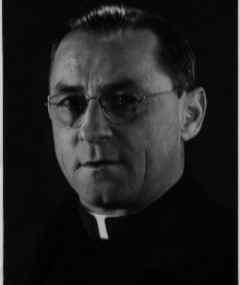


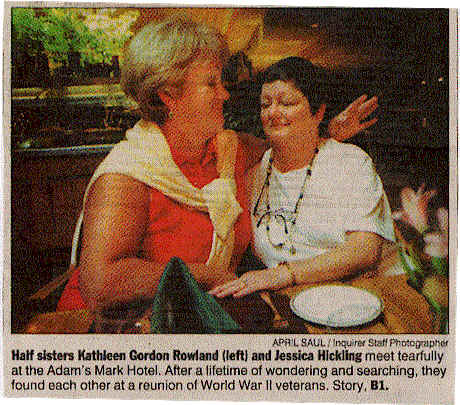

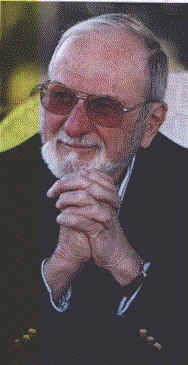
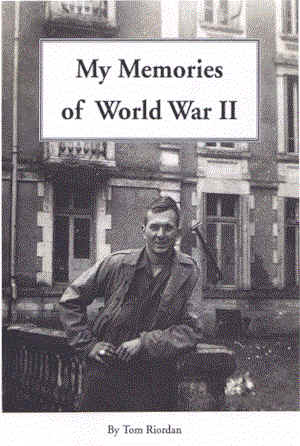

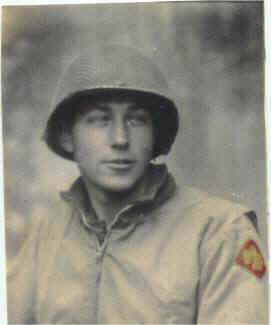

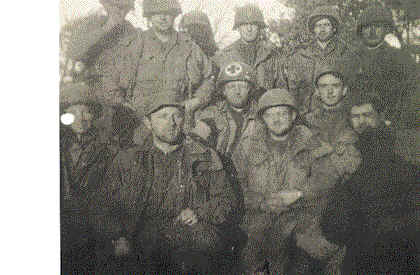

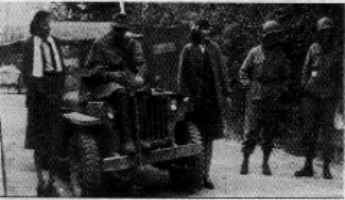

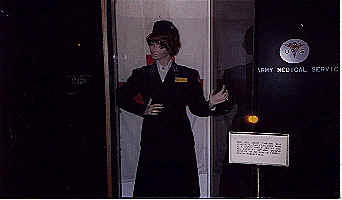

 Overview: The 157th Infantry at Reipertswiller, January '45
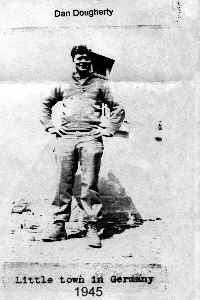

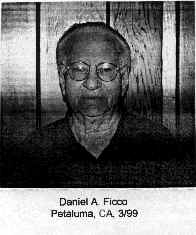

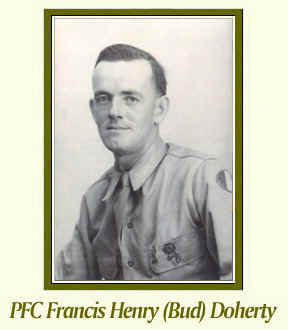
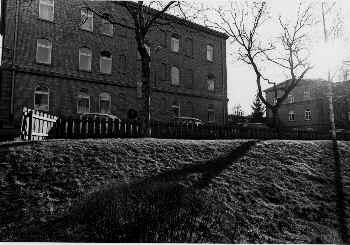
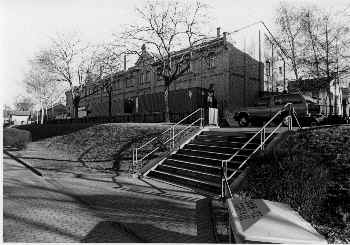
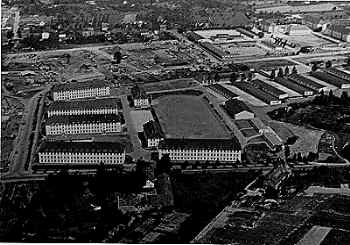

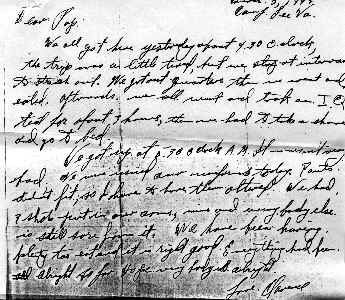
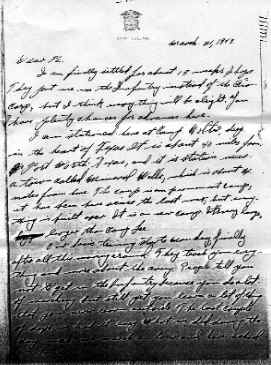
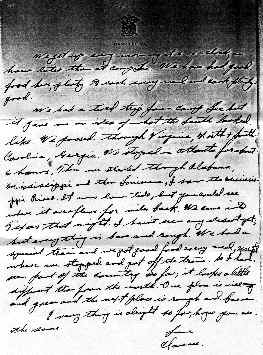
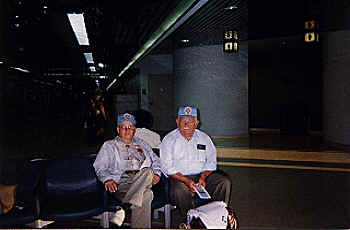
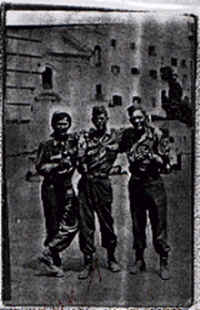
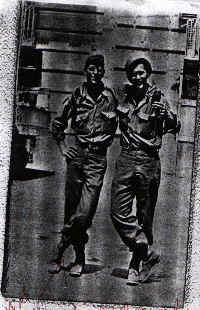


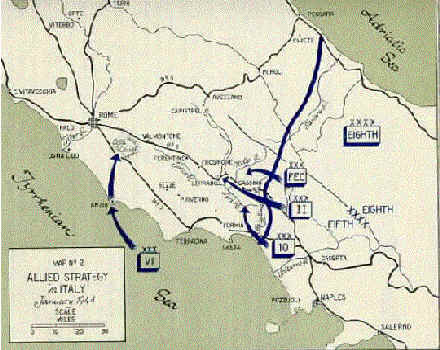
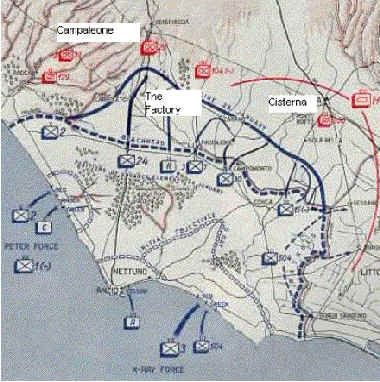
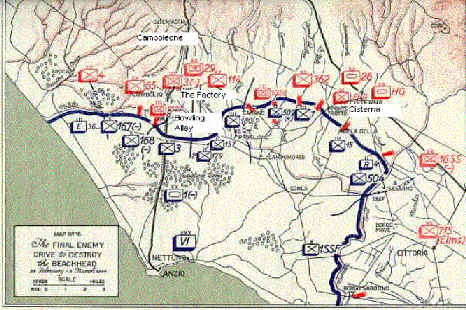
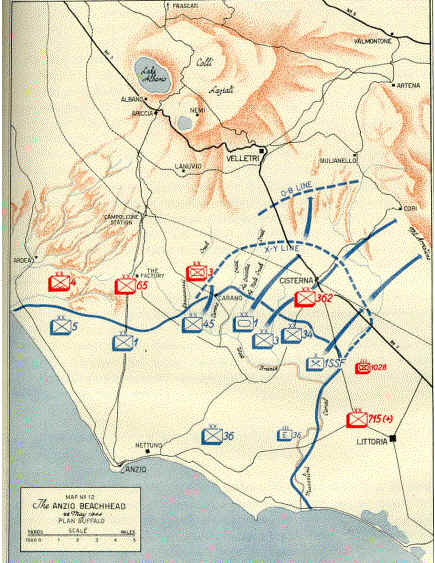

©
Copyright 1999 - 2005. All Rights Reserved. Please contact the Webmaster with any questions or comments.